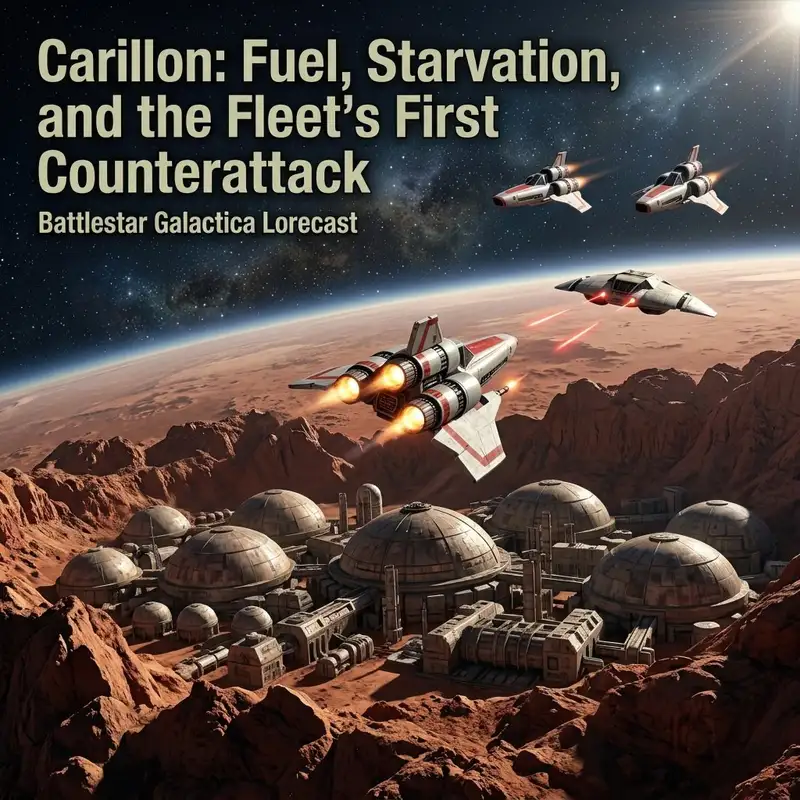
Carillon: Fuel, Starvation, and the Fleet’s First Counterattack
Colonel Tigh’s problem was not a tactical map. It was a survival ledger. The refugee fleet had escaped the destruction at Cimtar, but it had not escaped its consequences. Food stores had been contaminated. Rations had been cut sharply, reported in the crisis briefings as reduced by two-thirds. Ships were breaking down, and others had exhausted their fuel. Those figures should not be mistaken for a perfect census of a fleeing armada, but they establish the condition of the fleet clearly enough. Galactica was leading civilians who could not just keep running because their engines, kitchens, water systems, and bodies had limits. Rumors of a world with food, fuel, and comfort therefore carried more force than any command order. Yet to Commander Adama, the perfection of that promise was itself a warning. A fleet that has just survived betrayal and annihilation has reason to distrust any refuge that appears exactly when it is most desperate.
The immediate military mission after Cimtar was withdrawal. The larger mission was preserving enough people, ships, and institutional order to make withdrawal mean something. Galactica had become the armed shield of a population that no longer possessed a secure home, a functioning government center, or dependable supply lines. The battlestar could fight, launch Vipers, coordinate Colonial Warriors, and impose some order on a frightened convoy. It could not manufacture food from empty holds, repair every civilian ship with improvised parts, or command civilians to forget that they were hungry.
That distinction shaped everything that followed. A warship can survive damage and continue fighting. A refugee fleet must also feed children, maintain sanitation, preserve skills, care for the sick, and keep thousands of frightened people willing to cooperate. The Cylon attack had not just destroyed military forces. It had broken the network of farms, industry, transport, government, and ordinary life that made a civilization sustainable. Every subsequent movement of the fleet was therefore both a naval maneuver and a humanitarian gamble.
The Nova of Madagon made that gamble visible. The route through the dangerous starfield offered passage, but the Cylons had turned it into a barrier with mines. Galactica’s fighters had to clear a path for ships that lacked the speed, protection, or maneuverability to force their way through alone. The operation was not the kind of battle that produces a simple victory tally. Its value lay in opening a corridor through which civilians could survive.
But clearing a route cost fuel, time, aircraft readiness, and pilot endurance. Colonial Warriors sent into the Nova were not available somewhere else. Vipers committed to mine clearance could not simultaneously maintain a protective screen around the fleet. A damaged fighter or lost pilot mattered far beyond a single sortie because Galactica could not assume that replacement aircraft, trained crews, or secure bases waited ahead. The fighters were not an inexhaustible symbol of Colonial power. They were a dwindling working force, dependent on maintenance crews, parts, fuel, recovery operations, and a ship that had to remain alive long enough to launch them again.
The civilian ships made the problem harder still. A convoy does not move at the pace of its strongest vessel. It moves at the pace of ships with failing drives, uncertain fuel, crowded compartments, and captains trying to hold their own people together. A battlestar can choose a dangerous course because it has armor, weapons, trained personnel, and disciplined command. A civilian transport carrying families and depleted stores has fewer choices. The Nova of Madagon was therefore not just a hostile region of space. It was a lesson in the price of mobility. The fleet could move, but only by spending the resources that movement was meant to preserve.
Once through the Nova, Adama faced the question that haunts every force operating without a secure rear area. Where can it stop? A fleet that never pauses eventually loses ships to mechanical failure, loses people to exhaustion, and loses political consent to despair. A fleet that stops carelessly may hand the enemy its location, its initiative, and its population. The choice was not between caution and comfort. It was between different forms of danger.
The pilot’s account establishes that Adama had already rejected a tempting proposal for a supply stop because the convenience of the offer seemed suspicious. The enemy knew the fleet was hungry. The enemy knew it needed fuel. A source of food, water, and power that appeared too conveniently on the route of a hunted population might be a gift. It might also be a lure. Adama’s judgment was not mystical intuition. It was intelligence discipline shaped by recent catastrophe. The Cylons had won their initial success through deception as well as force. A commander who ignored that fact because his people needed relief would not be compassionate. He would be predictable.
Still, the people pressing for relief were not reckless caricatures. They were survivors of the destruction of their worlds. They lived aboard ships never designed to become permanent towns. They faced hunger, uncertainty, confinement, grief, and the growing realization that no rescue was coming from the civilization they had known. For them, a chance to eat well, sleep on solid ground, and step out of crowded passageways was not an indulgence. It was a claim to dignity.
That claim became more urgent as civilian leaders began reconstructing political authority. The destruction at Cimtar had not erased the idea that civilians possessed rights, representation, and a voice in their own future. It had only made those rights difficult to exercise. Galactica had weapons and a coherent chain of command. The civilians had numbers, needs, and the legitimacy that comes from being more than passengers in a military convoy. The tension between those forms of authority would define much of the fleet’s journey.
Carillon arrived in that atmosphere of scarcity and distrust. The world appeared to offer what the fleet lacked. It had food. It had water. It offered visitors rest, entertainment, and a surface life that resembled normality more closely than anything available aboard the ships. Most importantly, it appeared to possess abundant tylium, the fuel that allowed Colonial vessels and Vipers to continue moving, patrolling, launching, and defending themselves.
Tylium was more than a valuable mineral or a convenient plot device. For a refugee fleet, fuel was freedom of action. Without it, civilian ships could not remain with the convoy. Fighters could not sustain patrols. Galactica could not reliably screen the civilians against the pursuing Cylons. Fuel scarcity narrowed every decision. It forced commanders to choose between reconnaissance and defense, between travel and reserve, between sending help now and preserving the means to help later. A world with tylium therefore looked less like a luxury than a possible reprieve from strategic paralysis.
Carillon also carried a warning. Baltar had previously surveyed the world and reportedly found little or nothing of value there. Now the fleet encountered a substantial mining operation and deposits important enough to transform its prospects. The discrepancy did not provide a complete documentary history of how Carillon became what it was. The released story does not offer a full intelligence file, a formal treaty, or a detailed chronology of Cylon arrangements on the planet. But it did give Adama reason to question why a place once dismissed as unimportant had become such an attractive source of precisely the resources the fleet needed.
The surface hospitality made caution harder. Carillon’s resort did more than offer calories. It offered a temporary escape from grief. Visitors could eat, drink, socialize, and imagine that the emergency had ended. That mattered because hunger is not only physical. Prolonged confinement and fear create a hunger for normal life, for beauty, for pleasure, and for the ordinary rhythms of peace. The more the refugees experienced Carillon as a refuge, the more difficult it became to treat it as an unverified military objective.
Adama did not forbid all access. He authorized the collection of food and the acquisition of fuel. That was a practical decision. The fleet needed both. But he refused to declare Carillon secure or permit the population to abandon its ships for the surface. His position rested on a hard operational truth. The Cylons remained at war with the fleet. The battlestar still required crews, pilots, fuel, communications, and an alert force able to respond if an enemy appeared.
Colonel Tigh and Athena understood the same problem from the working level of fleet defense. Every person moved to the surface required transport, coordination, and eventual recovery. Every Colonial Warrior assigned to supervise mining, conduct reconnaissance, escort shuttles, or investigate the planet was a Warrior not available for immediate defense. Every Viper launched on a surface mission consumed part of the margin required to meet a Cylon attack. The fleet could not turn its entire population into tourists without hollowing out the military system that protected them.
Readiness can disappear without a shot being fired. It erodes when guards assume there is no threat, when pilots are dispersed, when maintenance cycles are deferred, when ships become crowded with people who should be at stations, and when leaders begin treating a temporary pause as peace. The danger was not that civilians wanted rest. The danger was that the apparent abundance of Carillon encouraged everyone to make plans based on a security judgment that had never been established.
That is why the disagreement over Carillon became more than an argument about shore leave. Civilian representatives moved to organize themselves into a new Quorum of the Twelve. Their effort mattered because it asserted that the collapse of Colonial civilization had not made military command the only source of legitimate authority. The survivors were still citizens. They still had interests that could not be reduced to what was convenient for Galactica’s battle plan.
Their case had force. A commander can order a defensive posture, but he cannot indefinitely govern through warnings alone. Hunger, fatigue, overcrowding, and the absence of a future can destroy discipline as surely as an enemy attack. Civilian representatives wanted access to the food, rest, and resources that Carillon appeared to provide. They also wanted a say in how the fleet would live. To them, Adama’s restrictions could look less like prudent caution and more like a military officer deciding that civilian life must remain suspended for as long as he considered danger possible.
Adama’s counterargument was equally serious. Civilian authority could not protect the fleet if it stripped Galactica of the means to defend it. The battlestar was not a government in itself, but it was the fleet’s only credible instrument of immediate force. If the Quorum’s demands scattered personnel, depleted fuel, and weakened alert status at the wrong moment, constitutional principle would not stop Cylon weapons. Adama was not claiming that he owned the future of the survivors. He was insisting that there might be no future if the fleet forgot it was still under pursuit.
Carillon exposed a problem with no easy answer. Civilian control is necessary because survival without political dignity becomes mere endurance under armed supervision. Military readiness is necessary because political dignity cannot survive if the population is destroyed. The fleet needed both, but catastrophe had left it without the settled institutions that usually manage the relationship. There was no intact capital to mediate disputes, no secure judiciary, no established territory where normal politics could proceed without immediate military consequences. The Quorum’s emergence was an act of political survival. Adama’s restrictions were an act of military survival. Carillon made those needs collide.
While the leaders argued over access and authority, Colonial personnel discovered what the resort actually was. Apollo, Starbuck, Boomer, and other Warriors found that the abundance of Carillon concealed an underground system of predation. The Ovions who operated the resort welcomed visitors, fed them, entertained them, and isolated them. Then selected guests were taken below the surface and consumed.
The horror of that discovery did not depend on graphic detail. Its strategic meaning was clear enough. Carillon’s hospitality was not benevolence. It was an intake system. Food, comfort, and diversion were being used to lower suspicion and draw vulnerable people away from the ships that protected them. Hunger had made the refugees susceptible. Exhaustion had made them willing to believe. The resort transformed the civilian need for relief into a weapon against the fleet.
The Ovions were more than an incidental danger lurking beneath a pleasant setting. Their presence was tied to the larger Cylon threat. The released story establishes an association between the Ovions, the planet’s tylium wealth, and Cylon interests on Carillon. It does not provide enough evidence to map a complete shared hierarchy or formal political agreement. What it shows is sufficient. Carillon functioned in a way that benefited the Cylons. It endangered the refugees, held a valuable fuel resource, and created conditions under which the fleet could be immobilized, divided, or destroyed.
This was layered deception. The resort made the planet attractive to civilians. The tylium mines made it indispensable to military planners. The underground trap exploited the gap between those two needs. A commander could not just dismiss Carillon because the fleet required supplies. Civilians could not safely embrace it because the military need for fuel did not make the location secure. The same place that seemed to solve the fleet’s logistical crisis was designed to deepen it.
Once the truth emerged, the mission changed. The first task had been extraction. Gather food. Obtain fuel. Recover enough strength to continue the flight. The second task became escape. Get personnel and civilians away from a compromised planet before more people vanished into the Ovion system or a Cylon force arrived. Then came a third task, more difficult and more consequential. Deny the enemy the use of Carillon.
Starbuck and Apollo’s decision to ignite the tylium mines was not casual sabotage, and it could not be reduced to revenge for the trap. It was a denial operation carried out under conditions of extreme scarcity. The Colonials needed the fuel. Their ships had already suffered from shortages and breakdowns. They had no demonstrated ability to replace a mining complex of Carillon’s apparent scale, no secure industrial base, and no guarantee that another comparable source would appear along their route.
Yet leaving the mines intact meant leaving a strategic resource in enemy-connected hands. It also meant allowing the Ovion trap to remain in place, ready to threaten more refugees and potentially serve Cylon interests again. The Colonials therefore faced one of the cruelest decisions in military logistics. They had to destroy something they urgently needed because they could not safely control it.
That choice makes sense only when tactical and operational needs are separated. In the immediate engagement, tylium was fuel the fleet could use immediately. Across the wider mission, a functioning fuel source under hostile influence could sustain the enemy, lure future victims, and become a fixed danger along the fleet’s path. Carillon was not a supply depot that Galactica could seize, defend, and integrate into a secure network. The fleet lacked the troops, time, intelligence, and territorial depth required to hold it. Possession was never truly available. Denial was.
The destruction of the mines also reveals the industrial poverty of the refugees. Before the Cylon attack, the Colonies could survey worlds, operate fleets, mine resources, and maintain a broader economy. After Cimtar, Galactica and the civilian ships could improvise repairs and exploit opportunities, but they could not recreate the depth of a civilization’s industrial system. The loss of Carillon’s tylium was therefore not a painless tactical choice. It was the sacrifice of a resource the fleet could scarcely afford to lose.
As the plan unfolded, the fleet faced evacuation under threat. Personnel had to be recovered from the surface and from the mine area. Civilians had to be moved away from danger. Shuttles required escorts. Fighters had to cover the withdrawal while preserving enough readiness to confront the enemy. Civilian ships had to prepare to depart, despite fuel shortages, damaged systems, and the confusion that follows the sudden collapse of an apparent safe haven.
An evacuation is rarely clean. It is not one order followed by one movement. Different people learn the truth at different times. Some are already in transit. Some are on the surface. Some are aboard ships that may not be ready to move. The command problem extends beyond saving every individual. It is how to preserve the ability of the larger force to leave before the enemy can trap it in place. That does not make individual lives expendable. It makes timing merciless.
The approaching Cylon basestar sharpened every decision. A refugee fleet tied to a planet is vulnerable because it has reduced freedom to maneuver. Ships may be clustered around shuttle routes. Fighters may be committed elsewhere. Civilians may be ashore. Commanders may be trying to reconcile conflicting reports while political leaders demand answers. The basestar did not have to destroy Galactica in a fair engagement. It only needed to arrive while the fleet was divided and unable to jump away together.
Galactica’s initial fighter response was limited and pressured. The pilot’s script frames the situation through dramatic language about a small number of Colonial fighters confronting a much larger Cylon force. That should not be treated as a precise, audited order of battle. What matters is operational rather than numerical. The Colonials did not meet the attack with comfortable superiority. They launched what they could while other forces were still returning, preparing, or committed to the evacuation.
Blue Squadron’s arrival mattered because it bought time. The purpose of its action was not to destroy every Cylon attacker. It was to disrupt the enemy, slow the assault, and prevent the basestar’s supporting force from overwhelming the fleet before additional Vipers could launch. In convoy defense, time is a weapon. A few moments can allow a shuttle to clear a landing area, a fighter to launch, a ship to complete preparations, or a commander to make the decision that keeps the formation from collapsing.
That helps explain why fighter effectiveness cannot be measured only in destroyed enemy craft. A Viper protecting a shuttle, delaying an attack, identifying an approaching threat, or forcing the enemy to maneuver has served the fleet even if it does not produce a spectacular score. Galactica’s Warriors were not fighting for a clean battlefield victory. They were fighting to preserve the conditions of escape.
The Colonials could not win by matching the Cylon force aircraft for aircraft or by relying on firepower alone. Their advantage came from recognizing that the enemy’s information was incomplete. Apollo and Starbuck used low-level flight and deceptive communications to create the impression that a larger Colonial fighter force was approaching. The plan did not require the Cylons to be foolish. It required them to make a decision under uncertainty.
The distinction has practical consequences. A commander facing an unclear threat must choose between competing risks. If the approaching Colonial force appeared larger than it was, the Cylon commander had reason to seek a position that seemed safer, more defensible, or more advantageous. The deception turned Carillon itself into the decisive hazard. The planet was already in the process of catastrophic destruction because its tylium mines had been ignited. The Colonials needed the basestar to move close enough that the consequences of that destruction would reach it.
The Imperious Leader aboard the basestar ordered the vessel toward Carillon. It is tempting to describe that choice as panic, but the released story supports a more disciplined interpretation. The Cylon command was responding to the threat it believed it faced. Apollo and Starbuck had manipulated the enemy’s picture of the battle. They did not defeat the basestar by proving that the Colonials possessed greater numbers. They defeated it by making the Cylon commander act on a false assessment.
The chain reaction on Carillon completed the denial operation. The mines that could not be held, the resource that could not be safely exploited, and the trap that had endangered the refugees became a weapon against the pursuing force. Carillon’s destruction took the basestar with it. The Imperious Leader aboard was destroyed as well. For the first time in the released chronology after the fall of the Colonies, the fleet had achieved a clear and meaningful counterattack against a major Cylon force.
It was an extraordinary result, but it was not the reversal of the war. Galactica had not rebuilt the Colonial Fleet. The survivors had not recovered their worlds, established a secure supply line, or gained the strength to meet the Cylons in a conventional campaign. They had escaped a trap, destroyed a basestar, and preserved enough freedom of movement to continue. That was a tactical success and an operational reprieve. It was not strategic victory.
The Cylon pursuit continued. A new Imperious Leader emerged, and Baltar remained available to direct the hunt. The destruction of one Cylon command element mattered because it removed immediate pressure and demonstrated that the refugees could impose costs on their enemy. But the Cylons retained the broader initiative. They still possessed the force, reach, and political purpose to pursue the surviving Colonials across space. Carillon did not make the fleet safe. It proved only that the fleet was not helpless.
Politically, Adama’s caution had been vindicated. Carillon was a trap. The warning signs had been real. His insistence on maintaining readiness had helped prevent the entire population from becoming vulnerable on the surface at once. But vindication did not grant him unlimited authority. The civilians had been right about one essential fact as well. Hunger, exhaustion, and confinement were not secondary concerns that could be postponed until after victory. They were the conditions that made Carillon’s false hospitality so effective in the first place.
The Quorum’s challenge therefore remained important even after the planet’s destruction. Civilian authority could not just dismiss military expertise when survival depended on alert fighters and disciplined withdrawal. Military authority could not dismiss civilian suffering when that suffering shaped every political decision and every security risk. The fleet would need mechanisms for disagreement, representation, and consent precisely because emergency conditions made unilateral command so tempting.
Carillon also taught a harsher logistical lesson. The fleet survived by destroying the fuel source it had sought. That is the opposite of normal resupply. A commander usually hopes to seize resources, protect them, and use them to extend operations. At Carillon, the resource was too dangerous to possess. The Colonials gained time, not a supply base. They denied the Cylons a valuable asset, but they also denied themselves the same asset. The fuel crisis was not solved. It was deferred.
For the civilians, the lesson was crueler still. The resort had worked because it offered real things that people needed. Food was real. Rest was real. Relief from shipboard confinement was real. The danger was not that the refugees were foolish enough to enjoy comfort. The danger was that an enemy could understand their needs and weaponize them. After Carillon, no promise of safety could be evaluated only by how much it offered. The fleet would also have to ask who benefited, what information was missing, and what price might be hidden beneath the welcome.
Carillon was the fleet’s first counterattack because it converted weakness into leverage. Galactica did not regain conventional superiority. Its fighters were stretched, its civilians were hungry, its political authority was contested, and its supplies were uncertain. What it possessed was a commander willing to mistrust an easy answer, Warriors capable of adapting under pressure, and enough cohesion to turn an enemy’s incomplete information against it.
The victory was defined by denial rather than possession. The fleet did not capture a base, secure a mine, or recover the power it had lost at Cimtar. It escaped starvation and ambush by sacrificing the fuel source it needed, then made that sacrifice destroy a superior Cylon force. Carillon proved that fighting back and becoming safe were not the same thing. A refugee fleet could remain militarily dangerous only if it understood that food, fuel, vigilance, and civilian trust were all parts of the same battle.