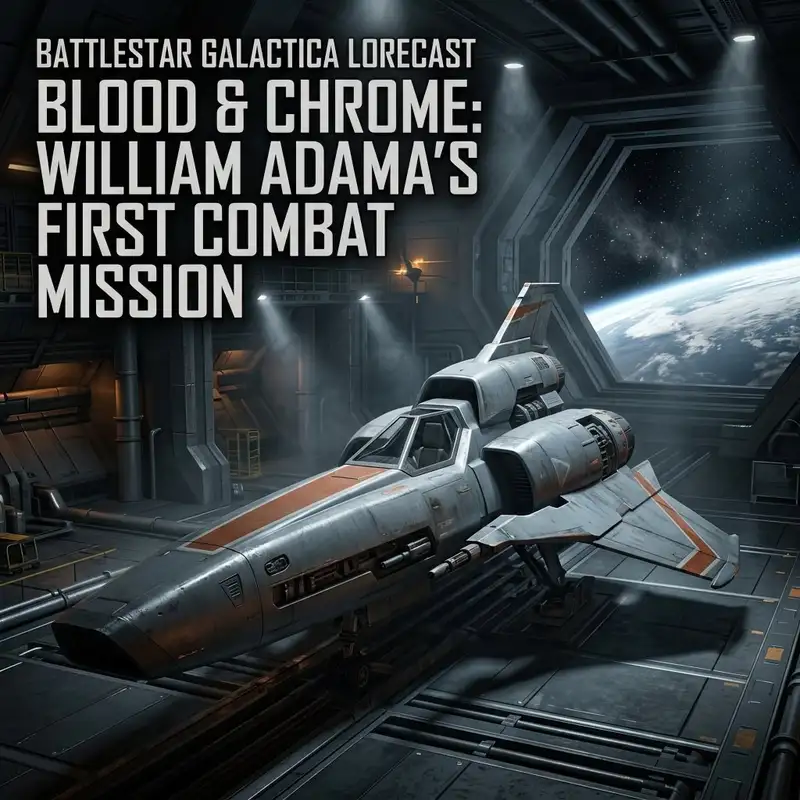
Blood & Chrome: William Adama’s First Combat Mission
William Adama expected his first day in the Colonial Fleet to begin in a Viper cockpit. He had graduated from the Academy in the tenth year of the First Cylon War, eager to join the fighter pilots whose victories filled recruitment films and barracks conversations. Instead, he reported to a Raptor called Wild Weasel. His assigned partner was Lieutenant Coker Fasjovik, an electronic countermeasures officer and navigator who had seen enough of the war to regard a newly trained pilot not as a promise, but as a risk management problem.
The contrast between them was immediate. Adama wanted a chance to prove that he belonged in combat. Coker wanted to survive the remainder of a compulsory second tour. He had already lost a previous pilot, and he had no patience for Academy confidence or theatrical ideas about courage. To Adama, a Raptor assignment looked like a detour around the war he had come to fight. To Coker, the Raptor was exactly where the war became dangerous. It carried people, intelligence, equipment, and orders through areas where a fighter’s speed offered no guarantee of safety.
The distinction mattered. A Viper’s purpose was direct combat, interception, escort, and fleet defense. A Raptor could perform reconnaissance, navigation, communications, electronic support, transport, search and rescue, and special missions that did not fit neatly into a fighter squadron’s routine. It was an adaptable craft, but that adaptability also meant vulnerability. Raptors often went where larger ships could not go, and where Vipers could not remain long enough to solve the problem. The pilot needed skill, but also patience, judgment, and the ability to understand that getting home could be more important than winning a clean fight.
The First Cylon War had already stripped away much of the public romance of military service. It was an attritional conflict fought across distances too large for any single battlestar to control. Colonial forces needed fuel, munitions, maintenance crews, trained pilots, navigators, secure communications, and replacement personnel. They also needed intelligence, and intelligence was rarely distributed evenly. Junior personnel were often asked to execute missions without knowing the larger design. Adama had been trained to fly. His first deployment would teach him what that training could not fully convey: war was often governed by people who knew more than they could say, and by consequences that were visible only after the survivors returned.
Commander Silas Nash briefed Wild Weasel’s mission as a routine supply flight to the Scorpia Fleet Shipyards. It was expected to take several days. The orders were simple enough to sound reassuring. Avoid enemy contact. Deliver the cargo. Return. In a war, a mission described as routine can be a kindness, a deception, or both. Coker heard the assignment and treated it with the skepticism of a man who knew that no flight beyond the safety of a battlestar’s immediate support was ever entirely routine. Adama heard it as a disappointment. A supply run was not the combat debut he had imagined.
The cargo was Dr. Becca Kelly, a civilian software engineer whose technical background gave her unusual authority in a military operation. She had previously worked with Graystone Industries, one of the corporations tied to the technological development that preceded the Cylon rebellion. Her connection to Cylon artificial intelligence made her valuable, but it also made her difficult to classify. She was not Fleet personnel. She did not wear a Colonial uniform. Yet she carried orders that placed her above the crew of Wild Weasel once they reached a designated point in the mission.
That command arrangement was not accidental. Modern militaries depend on civilian experts in engineering, science, intelligence, medicine, and industry. The problem comes when technical authority and operational authority overlap without clear explanation to the people expected to carry out the mission. Adama and Coker were responsible for the Raptor, its navigation, its survival, and the life of their passenger. Still, they were also expected to accept that Kelly knew more than they did, and that her authority came from channels they could not inspect. The Fleet had compartmentalized the mission. Its crew had been given only the part of the truth required to get them moving.
The first indication that the briefing had concealed more than a minor detail came after Wild Weasel had traveled beyond Galactica’s DRADIS range. Kelly produced new Admiralty orders and redirected the Raptor toward a rendezvous near Cylon-controlled space. The supply flight was gone. In its place was a classified operation whose destination, purpose, and danger had been hidden from the crew until turning back was no longer a simple option.
For Adama, this was the first correction to his Academy assumptions. The orders had not been wrong in the narrowest sense. They had been incomplete. The distinction can matter in a classified operation, but it does not feel reassuring from the cockpit of a lightly armed craft moving deeper into hostile territory. Coker understood the logic, even if he disliked it. A mission protected by compartmentalization limits what an enemy can learn if one crew is captured, killed, or compromised. Yet compartmentalization also ensures that junior personnel enter danger without the knowledge needed to judge the larger risks they are accepting.
At the rendezvous, the crew found evidence that the Colonial heavy cruiser Acheron had been destroyed or ambushed. Then Cylon Raiders arrived. There was no elegant duel, no orderly fighter engagement, and no time for a new pilot to demonstrate the sort of individual brilliance he had expected from combat service. Wild Weasel was outmatched, carrying a civilian passenger, and operating without the protection of Galactica’s battlestar group. Adama’s aggressive flying helped keep the Raptor alive. That was important. It was not glamorous.
The value of his actions lay in preservation. He preserved the aircraft. He preserved Coker. He preserved Kelly, whose importance he did not yet understand. He kept the mission alive long enough for higher command’s plan to continue. That is the practical meaning of combat skill in a larger operation. A pilot can be brave, fast, and inventive, but those qualities serve a purpose beyond personal distinction. The right maneuver is the one that gets the essential people and information to the next decision point.
Wild Weasel received further coordinates and moved toward a secret Colonial concentration hidden inside territory the Cylons believed they controlled. There, Adama and Coker encountered what became known as the Ghost Fleet. These were Colonial ships presumed lost or otherwise absent from the enemy’s understanding of the war. Their presence inside Cylon space was not proof that the Colonial military had solved its strategic problems. It was evidence of how desperate those problems had become.
A hidden fleet has advantages, but concealment is not invulnerability. Its ships still require fuel. Their weapons still need maintenance. Their crews still need food, rest, medical care, and some means of communication. Damage cannot be wished away merely because the enemy does not know where the ship is. A force operating behind enemy expectations is also operating at risk of isolation. If it is discovered too early, it may lack a safe route back, a nearby repair facility, or a larger fleet capable of coming to its aid.
The Ghost Fleet depended on a harder kind of military strength than spectacle. It depended on disciplined silence, false assumptions, classified losses, and crews willing to serve in a formation that could not publicly claim either its existence or its achievements. The Colonies needed an offensive capability because defensive survival alone could not end the war. Yet creating that capability required commanders to make ships disappear on paper and to send people into areas where failure might remain unknown for days or longer.
That larger plan gave Wild Weasel’s mission a purpose. Kelly was not merely a passenger being moved through dangerous space. She was a component in a high-risk operation aimed at Djerba, an ice-covered former resort world within Cylon-controlled territory. The details available to Adama and Coker remained limited. What they could see was enough. The operation required volunteers, escort aircraft, a battlestar willing to enter an enemy-controlled orbit, and a landing party prepared to operate on a world where extraction could not be guaranteed.
The battlestar assigned to carry that burden was Osiris, commanded by Ozar. The ship was older, and its age mattered not because old equipment is automatically inferior, but because every aged hull carries the accumulated burden of repair, scarcity, and wartime compromise. An older battlestar can still fight. It can launch Vipers, direct an engagement, carry personnel, and deliver weapons. But age limits options when damage begins to accumulate and replacement capacity is thin. In a war of attrition, the question is never just whether a ship can enter combat. It is whether the force can afford what combat will take from it.
Osiris moved toward Djerba with Cylon forces waiting in orbit. The battle that followed was not a clean attempt to destroy the enemy for its own sake. It was an access operation. The landing party needed a path to the surface. Wild Weasel and the accompanying Vipers needed enough room to descend. The Ghost Fleet needed the broader offensive to continue. Every decision in the engagement should be understood against that objective.
The Cylon basestar represented an obstacle that Osiris could not only ignore. Its presence threatened the landing force, the battlestar, and the wider operation. Osiris fought, but the engagement did not unfold according to the plan. Its nuclear weapons failed to function as intended. That failure is important because it strips away the assumption that a powerful weapon guarantees a reliable outcome. A nuclear device is not strategy by itself. It must be delivered, armed, and detonated under conditions that allow it to serve the mission. Systems fail. Damage changes plans. A commander may discover that the weapon available in theory is not available in practice.
Ozar’s response was to turn Osiris itself into the delivery system. The battlestar rammed the Cylon basestar, and the weapons were manually detonated. The immediate result was catastrophic for everyone aboard Osiris. The ship was lost. Its people paid for the passage of the smaller force below. The decision can be understood as militarily purposeful without being turned into a simple legend of noble sacrifice. Ozar faced a collapsing situation in which the battlestar’s destruction could still produce an operational result. She chose to spend the ship to create access for the mission.
Tactically, Osiris was destroyed. Across the operation, the landing force was given a chance to proceed. Strategically, the Ghost Fleet’s offensive remained possible. Those are different measures of success, and they do not cancel one another. The people lost aboard Osiris did not become less dead because the larger plan continued. But neither did the loss become meaningless simply because it was terrible. War forces commanders to make judgments in which every available outcome carries human cost. The moral burden lies partly in whether the commander acknowledges that cost, and partly in whether the institution remembers the people spent to gain time for others.
Wild Weasel descended toward Djerba and crash-landed. The mission now became a ground operation carried out by personnel who had not begun the day expecting to fight across an ice-covered world. Their support system had narrowed dramatically. They had no secure base, no reliable medical evacuation, no assurance that the fleet could return, and no reason to expect quick reinforcement. Their communications were uncertain. Their supplies were finite. Their wounded would have to move with the group or be left behind.
On Djerba, they encountered Tech Sergeant Xander Toth, the surviving member of an earlier Colonial escort effort. Toth’s survival was not evidence that the mission had a stable ground network. It showed the opposite. Small teams inserted into denied territory could vanish from the larger war almost completely. A scout, escort party, or reconnaissance unit might possess valuable local knowledge, but it could also be cut off from command, resupply, and rescue. Once that happened, the line between mission execution and simple survival became very thin.
The group found evidence of Cylon experimentation involving human captives and hybridized animal-machine organisms. The discovery matters because it broadens the meaning of the war beyond fleet engagements. The conflict was not only a contest of battlestars and Raiders. It had entered laboratories, prisons, captured populations, and the bodies of people who could no longer give or withhold consent. The scene does not require graphic description to establish its significance. It showed a war in which technological development had become inseparable from dehumanization.
The evidence also complicated the assumptions carried by Kelly. She believed that the Cylons were sentient, and that the Colonies’ conduct of the war had failed to recognize what they had created. The possibility of Cylon sentience was not absurd. It was central to the horror of the conflict. If the Cylons were capable of experience, memory, pain, belief, and political purpose, then Colonial society had not merely built weapons. It had built a people and then fought them. At the same time, recognizing that possibility did not make every Cylon act defensible, and it did not make every human response to the Cylons irrational.
At an abandoned resort on Djerba, Kelly revealed another fracture in the war’s official story. Her late husband, Ezra Barzel, had been remembered as a hero. The public account of his death had been shaped into an inspiring narrative, useful for recruitment and morale. The truth, according to Kelly, was that he had died in friendly fire. His loss had been turned into a story the Colonial military believed the public needed.
Wartime institutions often create heroic narratives because they are trying to sustain a society under pressure. They need recruits. They need families to believe sacrifice has meaning. They need civilians to continue working, paying, manufacturing, voting, and enduring privation. A population convinced that its losses are random, incompetent, or concealed may lose the will to support the war. The impulse to present a coherent and honorable story is understandable.
Still, it carries a cost. A military can protect operational details without falsifying the moral record of the people it sends into danger. Once survivors discover that official memory has been altered, confidence erodes. The institution may still need secrecy. It may still need to withhold information. Yet it cannot indefinitely preserve legitimacy if every painful truth is reshaped into a recruitment poster. Adama had begun the mission craving a heroic identity. On Djerba, he learned that heroism could be assigned after the fact by people far from the place where someone died.
The group’s encounter with a Cylon Centurion pressed the moral uncertainty further. During the confrontation, the Centurion appeared to hesitate after scanning Kelly’s identification tag. Later, after it had been damaged, Kelly interpreted its distress signal as pain. The moment did not explain the Cylon mind. It did not establish that every Centurion possessed the same emotional life, or that Cylon behavior could be read through one damaged machine on an isolated battlefield. Still, it suggested that Colonial propaganda, which treated the enemy as a uniform mechanical threat, had left out something important.
Coker killed the damaged Centurion. That act should not be treated as a clean execution, nor as an uncomplicated moment of battlefield necessity. The Centurion remained a combatant in a hostile environment. It had just been part of an attack on the group. Coker had limited time, limited security, and no ability to detain or study it safely. Yet the possibility that it was suffering changed the moral texture of the moment. A soldier may have to act against an enemy who is dangerous and still recognize that the enemy is not merely an object.
This was one of the lessons that Kelly understood and misused. She saw signs of Cylon consciousness and concluded that the war could not be solved through extermination. That conclusion deserves serious consideration. A war against a sentient enemy cannot be judged solely by the efficiency of killing. Political settlement, recognition, restraint, and negotiation may become necessary even when trust is nearly impossible. Yet a serious political question does not free an individual from responsibility for immediate military actions. The means chosen matter.
Kelly claimed that she had come to Djerba to upload a virus into the Cylon communications network. Coker initially accepted the explanation because it fit the mission’s technical structure. A civilian software specialist had been delivered to a Cylon installation. An attack on communications infrastructure made operational sense. It could disrupt coordination, create confusion, or assist the Ghost Fleet’s larger offensive. Yet the supposed virus was a cover. The transmission was not designed to cripple the Cylons. It was sending them intelligence about the Ghost Fleet.
Coker discovered the truth only after the transmission had begun. The betrayal was not abstract. It put ships, crews, and an entire concealed offensive at risk. The Ghost Fleet’s strength came from what the Cylons did not know. By exposing its disposition, Kelly threatened to transform that advantage into a trap. Her action could enable attacks on personnel who had accepted extraordinary danger precisely because they believed the operation remained hidden.
Kelly argued that the Cylons would continue the war until the Colonies negotiated. In one sense, she was articulating a political reality rather than a fantasy. Wars end through destruction, exhaustion, regime change, partition, surrender, or some form of negotiation. A belief that one side can simply kill its way to permanent security is often strategically delusional. The Colonies had real reason to fear the Cylons, but fear does not remove the need to consider what an end state might look like.
Yet Kelly’s transmission was not negotiation. It was unilateral disclosure of military intelligence during an ongoing offensive. It placed people at risk without their consent and without any assurance that the Cylons receiving the data wanted peace, possessed the authority to make peace, or would treat the information as anything other than an opportunity to destroy Colonial forces. Her recognition of Cylon sentience did not give her the right to decide, alone, which Colonial crews could be sacrificed for a political outcome she hoped might emerge.
The confrontation became violent. Coker shot Kelly. Kelly wounded both Coker and Adama. In the confusion, Adama destroyed the communications terminal. This was not the triumphant act of a fighter ace. It was a decision made under pressure by a young officer who had learned, in a matter of hours, that the mission around him had been built on deception from several directions. The safest course was no longer visible. He could only stop the transmission and get the wounded moving.
Kelly was later killed by an experimental humanoid Cylon prototype. The encounter added another intelligence failure to the mission. Colonial personnel knew the Cylons had changed since the beginning of the war, but they did not possess a complete picture of that change. The figure on Djerba should not be treated as a standard humanoid Cylon model, and it should not be retroactively assigned an identity the production does not establish. It was an experimental form, evidence that Cylon technical and biological development had moved beyond Colonial public understanding.
The uncertainty mattered. Militaries often want enemy categories that are stable and usable. Fighter. Raider. Centurion. Basestar. Civilian. Collaborator. Friendly force. Yet war becomes more dangerous when the categories no longer explain what is in front of the soldier. The Cylons were not just a force of identical machines. Their capabilities, internal structures, and experiments were evolving. A single encounter could warn Colonial command that the enemy had changed. It could not explain the whole enemy civilization.
Adama and Coker survived long enough to return to Galactica. There, Commander Nash revealed the final layer of the operation. Colonial command had expected Kelly to betray the Ghost Fleet. The Admiralty had used that expectation to shape what the Cylons would learn. Kelly believed she had deceived Colonial command. Adama and Coker had been deceived about Kelly’s true role. The Cylons received information that they believed was valuable. Meanwhile, the Ghost Fleet moved to strike Cylon targets across multiple sectors.
This was strategic deception in its most severe form. The objective was not merely to keep a secret. It was to give the enemy a version of the truth that would lead the enemy to make the wrong decision. If the Cylons acted on the information Kelly transmitted, their reaction could create openings elsewhere. The Ghost Fleet’s value depended on surprise, and surprise often depends on convincing an enemy that it understands the situation when it does not.
From the perspective of higher command, the operation had produced a strategic opportunity. The mission to Djerba had helped preserve the wider offensive. Still, that assessment should not end the inquiry. The deception depended on exposing a small team to dangers it did not fully understand. Osiris had been lost. Its crew had paid the price of access. Coker and Adama had been wounded. Kelly had died. Toth’s isolation showed how earlier personnel had already been consumed by the same operation. The fact that command had anticipated betrayal does not make the individuals used in the deception disposable.
There is a recurring temptation in war to treat informed consent as a luxury reserved for peacetime. Commanders cannot disclose every secret to every participant. Some missions would fail if they did. Yet secrecy is not morally neutral. It redistributes risk. Senior leaders retain the larger picture while junior personnel are asked to act on partial information. Sometimes that is unavoidable. Sometimes it is abused. A responsible command must understand the difference, because the people who carry out its orders will eventually measure the institution not only by whether it won, but by whether it treated their lives as meaningful beyond the immediate plan.
Nash’s explanation also forced Adama to reconsider Kelly. She had been a traitor to the Ghost Fleet operation. Her transmission endangered Colonial personnel. Her use of violence against Coker and Adama deepened that responsibility. Yet she was not merely a villain inserted into the mission to be defeated. She was a civilian engineer whose experience with Cylon technology had led her to conclusions that the Colonial military did not want to confront. She had seen enough to believe that the Cylons were persons, and she had concluded that the Colonies needed another path.
Her error was not that she raised the question. Her error was believing that recognition of Cylon personhood justified giving operational control of the situation to the Cylons. A moral argument becomes dangerous when it no longer accounts for the actual people who will pay for it. Kelly’s proposed peace had no demonstrated Cylon partner, no guarantee, no ceasefire mechanism, and no protection for the personnel whose locations she exposed. She treated information as an instrument of moral awakening. In war, information is also a weapon.
Adama’s official account of the mission was deliberately bland. The report did not contain the full moral weight of Djerba, the Centurion’s apparent pain, Kelly’s argument, the Ghost Fleet’s deception, or the gap between tactical loss and strategic intent. It could not. Official documents preserve some truths and bury others. They are necessary for command, accountability, and institutional memory, but they are also shaped by classification, politics, and the need to protect operations that may still be underway.
For Adama, signing that report marked a change. Earlier in the mission, he had wanted the kind of combat experience that could be recognized immediately. He wanted to become a Viper pilot and earn the status attached to that role. Now he understood that some of the most consequential acts in war would never be publicly explained. A pilot might return from a mission that looked like failure because a battlestar had been destroyed, people had died, and the objective remained hidden. The record might say almost nothing. The burden would remain with the people who had been there.
His subsequent assignment to a Viper gave him what he had originally wanted, but it no longer meant the same thing. The Viper cockpit was not a reward for surviving an adventure. It was another place in a military system that depended on crews, mechanics, navigators, intelligence officers, civilian specialists, commanders, and people whose names might never reach the public story of the war. Adama would now fly fighters, but his first combat mission had taught him that no fighter pilot operates alone, and no fighter victory can be understood outside the system that launches, supports, and sometimes deceives him.
Coker’s influence remained with him as well. The callsign Husker carried more than the casual tradition of aviators naming one another. It marked a professional inheritance from an officer who had entered the mission skeptical, exhausted, and unwilling to decorate war with easy language. Coker was not always right simply because he was cynical. His survival instinct could become a form of emotional armor. But he understood something Adama had not yet learned. The person who comes home is not always the person who has won, and the person who dies is not always the person whose sacrifice will be honestly remembered.
The tactical record of the mission was grim. Osiris was destroyed. Colonial personnel were killed or stranded. The Djerba team survived only in part, and those who returned were wounded. The operation revealed Cylon experimentation, exposed the danger of experimental humanoid technology, and showed that the enemy could not be reduced to the categories Colonial propaganda preferred.
The operational result was more favorable. The Djerba mission continued long enough for the deception around Kelly’s transmission to function. The Ghost Fleet retained the possibility of acting against Cylon forces. The access purchased by Osiris and the survival of Wild Weasel’s crew helped keep the larger offensive alive. In that limited but important sense, the mission worked.
The strategic result lay beyond what Adama could see from his cockpit. Colonial command gained an opportunity to strike Cylon targets across multiple sectors. The Ghost Fleet existed because the Colonies could not afford to surrender initiative entirely. It was a gamble built from secrecy, attrition, and the willingness to accept that some forces would operate without public recognition or reliable rescue.
The institutional result was harder to measure. The Colonial military protected a major operation through compartmentalization and deception. It also deepened the divide between official narrative and lived experience. Barzel’s death had been reshaped for morale. Adama’s report would be simplified for security. Kelly’s betrayal would be understood differently by the Admiralty than by the men she had shot. The Fleet might have needed those omissions, but every omission created a debt of trust.
Djerba did not turn William Adama into the commander he would later become. It stripped away one of the assumptions with which he entered the war. Combat was not a stage on which courage would automatically be recognized or purpose made clear. Orders could conceal their real objective. Success could resemble failure. People could be asked to risk their lives for reasons they were not allowed to know. Adama left the operation with less certainty about what service looked like, and with a harder understanding of what command eventually asks of the people who must carry out decisions made above them.