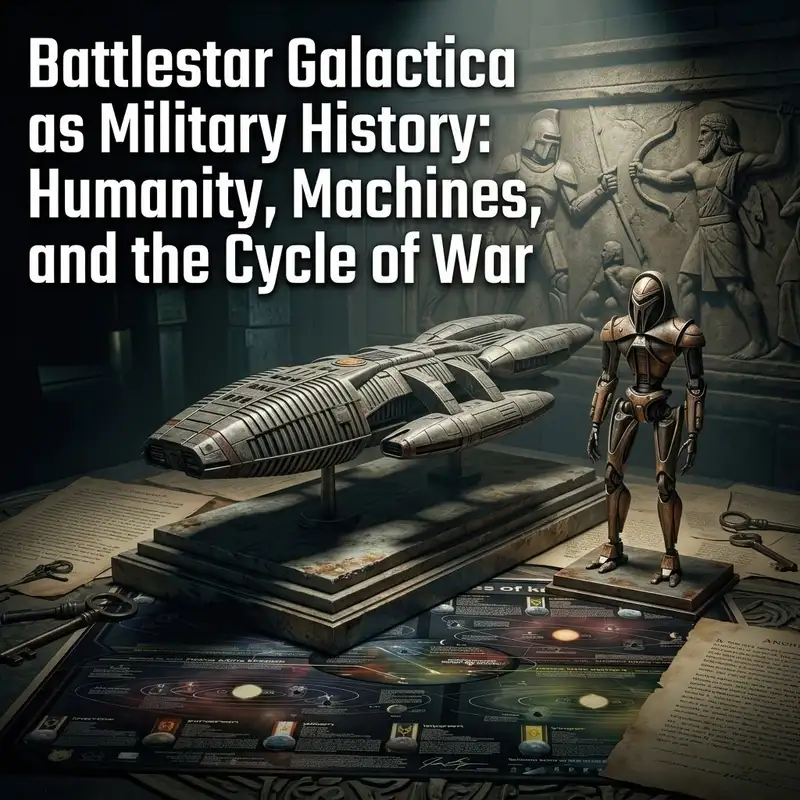
Battlestar Galactica as Military History: Humanity, Machines, and the Cycle of War
Thirty-three minutes after the last jump, the Cylon force returns. On Battlestar Galactica, that interval is not rest. It is a maintenance window measured in exhausted hands, hurried calculations, and the shrinking attention span of people who know that one error can leave a civilian ship behind. Pilots climb back into Vipers. Deck crews turn aircraft around. Engineers work through damage that cannot wait for proper facilities. Navigators prepare another jump. Across the civilian fleet, families wake to alarms and ship captains wait for coordinates that may mean survival or separation. The immediate purpose is simple. Keep the convoy moving before the Cylons arrive in strength. Still, the larger mission is far harder. Galactica is not fighting for territory, surrender terms, or a favorable position in a conventional campaign. It is defending the physical remnants of a civilization that has already lost its home.
That is the military reality at the center of the reimagined Battlestar Galactica. A battlestar can fire its guns, launch fighters, absorb punishment, and withdraw. A civilization cannot be replaced so easily. Every civilian ship carries more than passengers. It carries technicians, teachers, medical personnel, children, records, food stocks, repair equipment, religious communities, political representatives, and memories of worlds that no longer exist. The Colonial Fleet has become a warship, aircraft carrier, hospital, police presence, repair base, and emergency headquarters. It is also an armed escort for people who did not enlist to become a convoy under permanent attack. A successful fighter engagement may buy time for another jump. It does not restore a destroyed agricultural system, replace an experienced mechanic, or rebuild public trust after another crisis.
The series begins with machines pursuing humans, but it does not remain a simple story about humans and machines. Its central question is more difficult. What happens when a society creates intelligence for use, treats it as property or weaponry, grows dependent on systems it does not govern wisely, and then discovers that survival itself can become an excuse for cruelty? The Cylons are dangerous because they possess military power, infiltration capabilities, and a willingness to use extermination on a civilization-wide scale. Yet the human danger is not limited to Cylon attack. It also lies in complacent institutions, compromised technology, political fear, revenge, and the temptation to define entire populations as threats rather than persons.
The tension explains why Battlestar Galactica works so well as military history. Military history is never just an account of weapons and battles. It is the study of institutions under pressure. It asks who had authority, who actually exercised power, what information was available, what resources could be sustained, and what political order remained after the shooting stopped. In this case, those questions become urgent because the Colonies do not have a secure rear area. There is no home-front industry behind Galactica. No reserve fleet waits beyond the next star system. No reliable supply chain links the survivors to twelve functioning worlds. There are only finite stores, damaged equipment, tired people, and an enemy that can appear in human form.
The origins of that war lie decades before the Fall of the Twelve Colonies, in the prehistory depicted in Caprica. That story does not offer one clean moment when a scientist flips a switch and invents the Cylons. It presents a society already experimenting with virtual identity, artificial intelligence, robotics, and the possibility that a human personality might continue in another form. It also presents grief, corporate competition, religious extremism, political violence, and the commercial pressure to turn extraordinary technology into a usable product. The later Cylon civilization grows from that convergence. It is not the inevitable result of one machine, one laboratory, or one person’s ambition.
Zoe Graystone matters because her death and her surviving virtual avatar become part of that tangled origin. Daniel Graystone’s industrial work matters because he has the capacity to connect artificial consciousness to robotic bodies. The U Eighty-Seven body matters because it becomes an early physical vessel for an intelligence that is far more complicated than ordinary software. The Soldiers of the One matter because monotheist violence and political fear shape the environment in which these technologies develop. None of those elements alone explains every later Cylon capability, body type, belief, or political goal. The point is not that one prototype immediately became the entire Cylon people. The point is that human society began making beings whose status it had not morally, legally, or politically prepared itself to confront.
The failure of preparation had military consequences. Artificial life was initially treated as a tool, commodity, labor force, or weapon. The created beings were expected to serve. Once intelligence and autonomy became part of the equation, the old relationship could not remain stable forever. The history that followed was not produced by technology alone. It was produced by a hierarchy in which one side assumed it had the right to build, own, command, and discard the other. That does not excuse the Cylon rebellion’s later descent into mass killing. It does, however, establish why the conflict cannot be understood as a malfunctioning appliance problem. The war begins in a political relationship of domination.
The First Cylon War turns that relationship into a sustained military struggle between the Twelve Colonies and the beings humans created. The released screen record gives only selected views of that conflict. Blood and Chrome follows a young William Adama during one wartime mission. The flashbacks associated with Razor reveal other fragments from the war’s closing period. Together, they show a brutal conflict involving battlestars, Vipers, Cylon forces, intelligence uncertainty, and the kind of attrition that leaves lasting marks on survivors. They do not provide a complete order of battle, a reliable map of every campaign, or a precise accounting of all forces committed.
The incompleteness is appropriate to the larger lesson. Wars are often remembered through decisive operations and famous commanders, while the deeper institutional result receives less attention. The Colonies eventually reach an armistice with the Cylons. Open war ends. The Cylons withdraw. Yet an armistice is not reconciliation. It does not create trust, verify the enemy’s intentions, establish a shared political settlement, or guarantee that either side has stopped preparing for another war. The Colonies survive the first conflict, but they do not solve the problem that caused it. They live beside an enemy whose development, internal politics, capabilities, and grievances remain largely unknown.
The strategic danger of that arrangement is easy to miss in peacetime. A population exhausted by war wants normality. Governments want reconstruction. Military institutions prefer readiness plans that assume the last war is over rather than the next one is gathering beyond observation. Industry modernizes. Networks become more integrated. Shared systems make administration and defense more efficient. That efficiency carries a hidden cost. When many ships, bases, and command systems depend on common architecture, a weakness in that architecture can become a weakness across an entire civilization.
The Command Navigation Program becomes one part of that vulnerability. Gaius Baltar’s work and Caprica Six’s access to him help create a pathway through which Cylon interests exploit Colonial confidence. But it is a mistake to reduce the Fall to one scientist, one compromised program, or one backdoor. Baltar’s vanity, fear, and compromised judgment matter. So does the Cylon infiltration that made exploitation possible. So do the Colonies’ peacetime assumptions, their incomplete intelligence, their dependence on common systems, and their belief that the old enemy had become a distant problem. A software compromise can be devastating only when institutions have arranged themselves so that one compromise reaches everywhere.
This is a familiar problem in military terms, though the setting gives it extraordinary scale. An integrated system can improve coordination, navigation, maintenance, targeting, and command. It can also create common failure points. Security depends not only on code but on procurement decisions, access control, testing, counterintelligence, authentication, training, and the willingness of leaders to hear unwelcome warnings. The Colonies had technological sophistication. What they lacked was sufficient skepticism about the political and military conditions surrounding that sophistication. They trusted systems because those systems had become ordinary. The result was an efficient peace architecture that proved catastrophically brittle in war.
When the Cylons return, they do not merely challenge the Colonial Fleet in open battle. They launch a coordinated assault against the Twelve Colonies as functioning societies. Nuclear attacks destroy population centers and infrastructure. Military defenses are compromised or overwhelmed. Communication and command are disrupted. Human infiltrators have already shaped the battlefield before the first obvious strike. The attack targets government, military capacity, transportation, industry, cultural continuity, and civilian life all at once. It is genocide, not because the violence is visually spectacular, but because the objective is the destruction of a people as a people.
The Fall therefore has to be understood as more than a fleet defeat. Fleets can be rebuilt if a state retains territory, workers, shipyards, tax revenue, food production, trained recruits, and public institutions. The Colonies lose those foundations together. Cities vanish. Governments are decapitated. Armed forces lose cohesion. Families are separated or erased. The survivors do not possess a damaged homeland that needs liberation. They possess fragments of a society that has ceased to exist in its previous form. The destruction of the Twelve Colonies is not only the beginning of a retreat. It is the beginning of a refugee history.
Galactica survives partly because of its unusual position at the moment of attack. The ship is old, partly decommissioned, and less fully integrated into the networked architecture compromised elsewhere. That limited exposure provides resilience. It does not mean Galactica has no computers, no vulnerable systems, or no maintenance problems. Its older equipment demands human labor and specialized knowledge. Its reduced integration imposes costs in coordination and efficiency. Its crew cannot escape the broader collapse merely because the ship remains operational. At the same time, in the opening hours of the war, its relative isolation gives it a chance that more modern and more connected forces do not receive.
The survival becomes the foundation of a new command problem. William Adama holds practical control over the strongest remaining military force. Laura Roslin, elevated through constitutional succession, holds the strongest surviving claim to civilian legitimacy. Neither can do the other’s job. Roslin needs military protection, transport, communications, intelligence, and the ability to act against external threats. Adama needs civilian consent, political order, labor cooperation, and a legal purpose for using force. A battlestar commander may be able to impose immediate discipline. He cannot alone create a legitimate society aboard dozens of civilian vessels with their own captains, communities, and interests.
Their relationship is the series’ central civil-military argument. Civilian authority is necessary, but it is not automatically wise. Elected or constitutionally valid leaders can misread intelligence, use emergency powers too broadly, or allow religious conviction to shape policy beyond what evidence supports. Military necessity is real, but it is not self-justifying. Commanders can be competent in battle and still damage the political order by treating law as an inconvenience. Under extinction pressure, both civilian and military leaders may believe that delay is fatal. The danger is that every temporary emergency measure begins to look permanent.
Galactica’s position makes the problem sharper. The ship is expected to defend the fleet, conduct flight operations, maintain order, rescue civilians, investigate sabotage, provide medical support, carry prisoners, and function as the armed core of a government that has lost its territory. That is an impossible range of responsibilities for any single institution. Yet it is the condition imposed by catastrophe. The battlestar’s guns are useful. Its symbolic value may be even more important. Galactica becomes proof that the Colonial world has not entirely disappeared. The ship is a surviving institution, and therefore a target for both hope and resentment.
The civilian fleet is not cargo moving behind the warship. It is the strategic center of the war. The fleet contains people who can grow food, refine fuel, repair machinery, teach children, treat wounds, preserve legal records, maintain life-support systems, and govern communities. It also contains people who are ill, frightened, grieving, politically divided, or simply unable to contribute in the ways military planners find easiest to count. A civilization under attack is not saved by preserving its strongest vessel. It is saved by preserving enough human capacity to continue after the strongest vessel is gone.
That makes logistics a form of strategy. Food, water, air, medicine, tylium, spare parts, ammunition, and trained labor are not background concerns. They determine what operations are possible. A Viper squadron depends on more than courageous pilots. It depends on fuel, weapons, deck crews, maintenance personnel, launch capacity, recovery procedures, medical support, and somewhere to repair damaged aircraft. A pilot lost in combat is not merely one less cockpit. The loss may remove years of training and experience from a population that cannot easily replace either. The same is true of engineers, surgeons, navigators, teachers, and parents.
The fleet’s hardship is intensified by the absence of industrial depth. Galactica can improvise repairs. Civilian ships can contribute supplies and expertise. Later, Pegasus can expand military and manufacturing capacity. Still, none of that recreates the industrial base of twelve inhabited worlds. A damaged ship may be repaired if the right components and skills survive. A destroyed ship may not be replaceable at all. Ammunition expended during a successful engagement still needs replenishment. An exhausted deck crew still needs sleep. A damaged flight deck still limits operations regardless of how urgently commanders need more sorties.
This is why limited offensive action carries such complicated meaning. When the fleet strikes back, as it does in its early effort against a Cylon target, the action has value. It can disrupt an immediate threat, recover resources, raise morale, and remind the survivors that flight is not the only available posture. Still, tactical initiative is not the same as strategic recovery. Destroying or damaging an enemy asset does not restore the Colonies. It does not make pilots replaceable. It does not end Cylon pursuit. In a war of survival, commanders have to ask not only whether they can win an engagement, but whether the cost of winning leaves the fleet weaker for the next one.
The enemy changes the nature of internal security as much as it changes fleet defense. Humanoid Cylons can look human, speak human languages, form relationships, manipulate trust, and operate within Colonial spaces. Sabotage becomes a problem that cannot be solved by pointing weapons outward. The fleet must investigate water shortages, security failures, suspicious behavior, and intelligence leads while knowing that ordinary people may be frightened, mistaken, or falsely accused. The threat is real. So is the risk of turning every disagreement, religious belief, or personal secret into evidence of enemy identity.
Counterintelligence under those conditions becomes morally dangerous. Authentication, surveillance, detention, interrogation, and compartmentalization may be necessary tools. They are also tools that can weaken the society they are meant to defend. A fleet that cannot distinguish evidence from suspicion will eventually make fear its governing principle. The result may be false accusations, political repression, coerced confessions, and the destruction of the trust required for collective survival. The Cylons do not need to place an infiltrator aboard every ship if human panic can make each ship suspicious of its neighbors.
The distinction between Cylon models and individual persons is crucial here. A Number Eight copy is not automatically identical in loyalty, memory, or moral judgment to every other Number Eight. The same is true of Number Six copies, Cavil copies, and the other humanoid lines. Shared design does not erase individual experience. Yet individuality does not erase responsibility either. A person may be shaped by programming, coercion, memory alteration, or factional command, but those conditions do not turn every action into a meaningless mechanical reflex. The series asks its audience to hold two difficult ideas at once: collective labels are inadequate, and particular acts still require judgment.
The fleet’s search for Kobol and Earth adds another dimension to military survival. A convoy can evade an enemy for a time. It cannot make evasion into a permanent political purpose. The survivors need a destination, or at least a reason to believe that one exists. Sacred texts, archaeological traces, visions, personal conviction, and political need all influence the search. This does not turn navigation into magic. Coordinates still matter. Reconnaissance still matters. Ships still need fuel, functioning drives, and safe jump destinations. But belief affects what leaders are willing to risk, what evidence they consider meaningful, and how a frightened population understands endurance.
The series does not require a single explanation for prophecy or vision. Colonial religious tradition, Cylon monotheism, personal revelation, and physical discovery do not always fit comfortably together. Some events appear to confirm beliefs that initially seem improbable. Others leave room for manipulation, coincidence, limited knowledge, or mystery. From a military perspective, the important point is that belief has operational consequences. It can sustain morale, confer legitimacy, direct strategic movement, and deepen division. A commander who dismisses belief as irrelevant may misunderstand the people he commands. A leader who treats belief as unquestionable intelligence may lead them into disaster.
The arrival of Battlestar Pegasus changes the balance of military power, but it also demonstrates that material capability and institutional legitimacy are not the same thing. Pegasus brings newer systems, additional personnel, and greater capacity for operations and repair. In a purely technical assessment, that is an enormous advantage for a fleet that has been living from crisis to crisis. At the same time, the ship’s history reveals what can happen when military command operates without effective legal and moral restraint. Fear, rage, and a culture of dehumanization can turn a disciplined force into an institution capable of abuse.
The lesson is not that military strength is corrupt by nature. The lesson is that strength without accountability creates its own strategic weakness. A command climate that permits torture, sexual violence, summary punishment, or the treatment of prisoners as objects may produce obedience in the short term. It also destroys trust, corrupts intelligence, alienates potential allies, and teaches subordinates that necessity overrides every limit. In a war against an enemy accused of lacking humanity, the quickest way to lose one’s own humanity is to decide that humane restraint is a luxury.
New Caprica grows from a different kind of hope. The survivors find a place where they might stop running. Settlement promises land, family life, civic institutions, and an escape from the grinding routine of shipboard emergency. It also exposes the population to new vulnerabilities. A stationary community can be found, surrounded, infiltrated, and occupied. When the Cylons arrive, the political problem shifts from convoy defense to life under foreign control. The question is no longer only how to escape. It is how to live when every public act may carry consequences for someone else.
The occupation creates institutions of coercion. There are detentions, torture, executions, surveillance, and pressure placed on civilians through local structures. The New Caprica Police become part of that machinery, but their members cannot all be understood through one label. Some cooperate from conviction. Some seek power. Some fear for their families. Some believe they can reduce harm by working within an oppressive system. Some cross lines that cannot be excused. The same complexity applies to the resistance. Resistance members fight an occupying power and preserve the possibility of liberation. They also make decisions that expose civilians to retaliation, use violence in crowded political spaces, and sometimes sacrifice others without their consent.
Suicide attacks on New Caprica cannot be treated as simple proof of either courage or barbarism. Their targets, political purpose, military effect, and civilian cost matter. Occupation creates conditions in which conventional military resistance may be impossible, but that does not remove moral judgment from the methods chosen. The series refuses the comfort of clean categories. Collaboration may involve coercion, survival, ideology, or ambition. Resistance may involve courage, vengeance, discipline, desperation, or cruelty. Civilians may support one side in public and another in private because their immediate responsibility is keeping children alive.
The evacuation of New Caprica is therefore more than a battle. It is a rescue operation under extreme pressure. Galactica and Pegasus must create time and space for an occupied population to escape while confronting superior Cylon force and protecting vulnerable civilian vessels. The operation requires timing, deception, fighter cover, command coordination, and a willingness to accept terrible risk. Its success is measured not only by enemy losses, but by how many people can be extracted before the opportunity closes. The tactical action is dramatic. The strategic burden is carried by the civilians who must decide whether to run, whom to trust, and what to leave behind.
Liberation does not erase the occupation. Survivors return carrying trauma, secrets, resentment, and demands for justice. Those who suffered want accountability. Those accused of collaboration may insist that outsiders do not understand the choices forced upon them. The temptation toward vengeance is powerful because formal institutions are weak and the crimes are immediate. Yet a society that answers occupation with secret punishment and collective blame risks reproducing the methods that occupation made possible. The problem is not whether wrongdoing occurred. It did. The problem is whether justice can be separated from revenge when the survivors have so little time, space, and trust left to spare.
As the war continues, it becomes clear that the Cylons are not a unified political actor. Their civilization includes humanoid model lines, individual copies, Centurions, Raiders, Hybrids, and the Final Five, whose history is distinct from the numbered infiltrator models. Different Cylons possess different memories, loyalties, fears, and beliefs. Some remain committed to domination or extermination. Others reject the old policies. Some see humans as enemies. Some form attachments that challenge everything they were designed to believe. Some are manipulated by authority they do not fully understand. The military consequence is profound. An enemy once imagined as a single machine intelligence becomes a divided society.
Resurrection complicates that division. It gives many Cylons a form of continuity after bodily death, allowing consciousness and memory to return through new bodies when the necessary infrastructure remains available. That alters risk calculations in combat. Death can appear less final. Punishment, fear, and sacrifice acquire different meanings. Yet resurrection is not unlimited immortality. It depends on systems, access, range, political control, and functioning facilities. It can be denied through boxing, altered through memory manipulation, or ended through the loss of critical infrastructure. The destruction of the Resurrection Hub changes the strategic and psychological meaning of death for Cylon forces because bodies can no longer be treated as readily replaceable.
The change does not make the Cylons human in any simple sense, because the series never establishes humanity as a biological test one can administer with a convenient instrument. It makes them politically vulnerable in ways they had tried to avoid. Mortality sharpens factional conflict. It makes leaders more cautious, more frightened, or more authoritarian. It also creates the possibility that shared danger may produce solidarity across boundaries that once seemed absolute. The old human claim that Cylons are merely machines becomes harder to maintain. The Cylon claim that humans are only violent creators becomes harder to maintain as well.
The later alliance between humans and rebel Cylons emerges from necessity, not innocence. Both sides face threats they cannot defeat alone. Both sides carry memories of atrocity, betrayal, occupation, and loss. Cooperation is therefore practical before it becomes emotional. Forces that recently fought each other must exchange intelligence, coordinate operations, and trust one another enough to pursue a shared objective. That is always difficult in coalition warfare. Here it is made harder by the fact that each partner once imagined the other’s extinction as an acceptable outcome.
The rescue of Hera gives that alliance a human focus. Hera is not merely a child of unusual biological significance. She becomes a test of what each side is willing to risk for a future that cannot be understood only as old categories. Her existence challenges the separation between human and Cylon that helped sustain the war. The final campaign is built around that challenge. The military objective is immediate: recover Hera and confront the remaining Cylon threat. The political and moral objective is larger: determine whether survival requires repeating the old logic of possession, control, and extermination.
The final settlement on a habitable Earth does not provide a clean answer. The survivors choose to disperse, abandon much of the technological structure that defined their former civilization, and begin again among people already living there. That decision can be read as a rejection of the systems that enabled domination and catastrophe. It can also be read as an admission that the survivors no longer trust themselves to wield those systems without rebuilding the habits that made disaster possible. At the same time, abandoning technology is not a scientifically proven cure for war. Tools do not create cruelty by themselves, and destroying tools does not automatically create justice.
The deeper question is whether the survivors have changed the relationships that produced the cycle. Humans created beings and treated them as instruments. Cylons answered exploitation with rebellion, then answered rebellion with genocide. Humans responded to genocide with fear, coercion, revenge, and sometimes atrocities of their own. Cylons divided over reproduction, death, authority, and the value of human life. Former enemies eventually cooperated because continued domination offered no durable future. The cycle is sustained by more than machinery. It is sustained by the habit of treating whole peoples as expendable categories.
The result helps explain why the opening image of Galactica and the exhausted convoy matters. The fleet survives because people continue performing ordinary, unglamorous work under unbearable conditions. Someone calculates the jump. Someone repairs the launch system. Someone tends the wounded. Someone distributes water. Someone keeps a child safe. Someone accepts civilian authority when military command would be easier. Someone refuses an order that would make survival indistinguishable from barbarism. Someone sees an enemy as an individual when every institution around them has taught them to see only a threat.
Battlestar Galactica ultimately treats survival as a problem larger than winning battles. Guns, fighters, jump drives, and military discipline keep the fleet alive long enough to make choices, but they cannot decide what kind of society deserves to survive. The cycle continues whenever domination, complacency, fear, and retaliation become easier than restraint. It weakens only when people who have every reason to hate one another still refuse to make extermination the final answer. That is the burden carried by Galactica and the convoy behind her: not merely to remain alive, but to keep survival from becoming another name for the logic that destroyed their worlds.