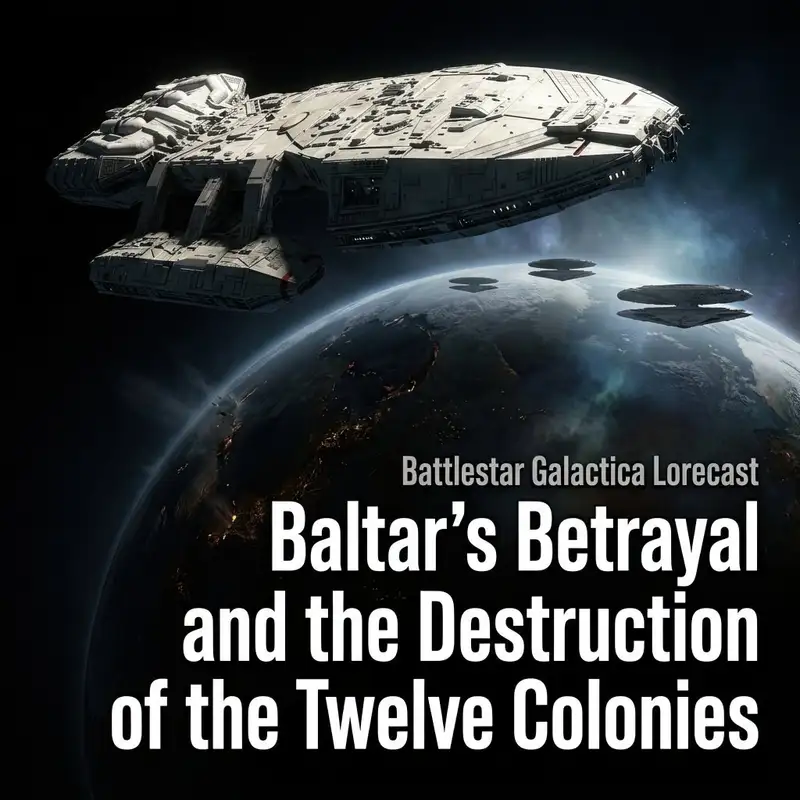
Baltar’s Betrayal and the Destruction of the Twelve Colonies
Apollo and Zac had been sent toward Cimtar on what should have been a limited reconnaissance patrol. A peace conference was underway. The Colonial government believed it was approaching the end of a war that had consumed roughly one thousand yahrens. The two Viper pilots were not looking for a battle. They were looking for an explanation for suspicious contacts near the conference area.
What they found was a concealed Cylon Raider force, hidden behind a moon and positioned to strike. The discovery transformed the meaning of the conference at once. The supposed armistice was more than failing. It had become part of the enemy’s weapon system. The Cylons had used diplomacy to draw Colonial political authority and major warships into one vulnerable place, then had placed an attack force close enough to exploit the resulting complacency.
Apollo and Zac tried to bring that warning home. Cylon interference prevented a clean report to the fleet, and Zac’s Viper was damaged during the attempt. He continued trying to reach the Colonial force, but his ship was destroyed before he could deliver a useful warning. His death mattered first as the loss of a son, a pilot, and a fellow officer. It also mattered as an intelligence failure with immediate strategic consequences. The Colonial command had received its warning from the field, but the warning had been delayed, fragmented, and politically inconvenient.
That was the real value of the Cylon ambush. It was not enough to conceal Raiders behind a moon. The Cylons had to keep the Colonials from understanding what they had found until the last possible moment. Jamming, distance, uncertainty, and the ordinary friction of command gave the deception time to work. By the time the evidence reached Commander Adama, the question was no longer whether a threat existed. The question was whether the Colonial government and fleet could shift from diplomatic posture to combat readiness before the enemy struck.
A civilization exhausted by a thousand yahrens of war had reasons to listen when someone offered peace. That does not make the Colonies foolish, and it does not make every advocate of negotiation a traitor. Long wars consume ships, crews, wealth, families, and political confidence. They create generations that know emergency measures better than normal life. A credible armistice offer would have carried enormous appeal, especially if it appeared to come through familiar political institutions rather than across a Cylon gun sight.
The Colonials were more than arranging a meeting between commanders. President Adar and the Quorum of the Twelve represented civil authority across the Colonies. Their presence at Cimtar gave the conference political legitimacy. It also concentrated leadership in one place. The assembled battlestars gave the proceedings military weight, but their presence created another vulnerability. A force gathered for ceremony, negotiation, and reassurance is not always organized for immediate battle.
Count Baltar stood at the center of that political opening. He was a human member of the Quorum and the intermediary associated with the peace initiative. He possessed something the Cylons could not manufacture on their own: credibility inside Colonial political life. He could speak the language of settlement, caution, procedure, and hope. He could reassure officials who wanted the war to end. He could make hesitation sound responsible and readiness sound provocative.
Commander Adama occupied a more difficult position. He was the commander of Battlestar Galactica, responsible for the lives and combat effectiveness of his crew. He also belonged to the political world gathered at Cimtar. His suspicion of the Cylon offer was not a rejection of civilian authority. It was the judgment of a commander who understood that an enemy with a thousand-yahren record of war deserved to be tested before being trusted.
The tragedy of Cimtar was not that the Colonials tried diplomacy. The tragedy was that they attempted diplomacy without preserving enough skepticism, dispersion, and readiness to survive a betrayal. Peace requires procedures. It also requires the ability to recognize when the other side is using those procedures against you.
Baltar’s betrayal was decisive, but it must be described precisely. The television presentation of the story establishes that he secretly reached an understanding with the Cylons. He expected that his own Colony would be spared when the attack came. That bargain reveals the moral core of his treason. Baltar was willing to trade the security of the Colonies for private survival.
What the story does not establish is equally important. It does not provide a complete biography explaining how he came to that decision. It does not show a broad human conspiracy operating beneath the Quorum. It does not demonstrate that Baltar designed the Cylon campaign, commanded Raider formations, selected every target, or possessed the military capability to destroy the Colonial civilization himself. He was not the master of the Cylon war machine.
He was the human enabler of that war machine’s most successful deception. His value lay in access, timing, and influence. The Cylons could bring Raiders, tankers, basestars, and overwhelming force. Baltar could help make sure the Colonials were gathered where those forces could hurt them most. He could help preserve the political confidence that kept the fleet from reacting too early. He could stand near the senior leadership of the Colonies and argue that prudence required delay.
That makes Baltar more, not less, culpable. A person does not need to pull every trigger to bear responsibility for an atrocity made possible by his decisions. In war, the person who opens the gate can be as consequential as the force waiting outside it. Baltar turned political trust into military vulnerability. He gave an external enemy access to the assumptions that governed Colonial decision-making.
His influence became most dangerous when Adama tried to move Galactica toward readiness. The reconnaissance evidence was incomplete but alarming. Apollo and Zac had encountered hostile forces where a peace conference was supposed to be protected by its own purpose. Adama asked for permission to launch fighters and place the fleet on alert. From his perspective, the risk was clear. If the contacts were harmless, the Colonials would have lost little by preparing. If they were hostile, delay could be fatal.
Baltar argued against immediate escalation. President Adar refused to authorize a full combat response in the middle of the negotiations. The decision must be understood in its political setting. A president who ordered fighters launched against a supposed peace delegation risked appearing to destroy the very settlement he had convened to achieve. A government cannot allow every military suspicion to become an independent declaration of war. Civilian authority exists partly to prevent armed institutions from deciding policy by alarm alone.
But civilian control depends on accurate information and honest advisers. Adar was making a decision under pressure, with incomplete intelligence, against the advice of a commander who believed the danger was immediate. Baltar’s role went beyond offering a different interpretation. He was secretly shaping the decision on behalf of the enemy. Adar’s error was grave, but it was not the same thing as Baltar’s treason.
Adama did not possess unlimited authority simply because he turned out to be right. He could not openly place the entire conference force into a war footing without confronting the President’s decision. Instead, he used a battlestations drill to prepare Galactica’s crews and fighters. It was a practical act of command under emergency conditions. It was also an act that exposed the weakness of the situation. A commander who believes his fleet may be attacked should not have to disguise readiness as an exercise.
The drill gave Galactica a margin the other ships did not have. Deck crews could move toward launch procedures. Pilots could be prepared. Command personnel could begin thinking in terms of contacts, intercepts, and defense rather than protocol. No single drill could erase every disadvantage. It could not restore Zac’s Viper, remove Cylon jamming, or reverse the political delay. But it changed Galactica from a ship caught completely at rest into a ship capable of fighting.
Cimtar had become a strategic trap because the Cylons had concentrated several kinds of value in one target area. The five battlestars visibly identified at the conference were Galactica, Atlantia, Acropolis, Pacifica, and Triton. They represented a substantial assembled force, but the story does not establish that they were the entire surviving Colonial Fleet. What matters is that major warships, important commanders, and the political leadership of the Twelve Colonies were close enough together for one attack to cripple organized resistance.
The destruction of warships was only part of the objective. The Cylons sought paralysis. They wanted to eliminate combat power before it could disperse, to kill or isolate senior leaders before they could coordinate a response, and to leave the Colonies without an organized defensive shield at the moment of planetary assault. The peace conference was therefore not a side episode before the real war began. It was the opening phase of the Cylon offensive.
The concentration at Cimtar also reflected a familiar danger in civil-military affairs. Institutions often arrange themselves around the event they expect. The Colonies expected a peace settlement. Their leaders gathered for diplomacy. Their ships adopted a posture appropriate to diplomacy. Their procedures were built around avoiding an accidental escalation. The Cylons expected betrayal. Their procedures were built around exploiting it.
When the Raider attack began, those different expectations became visible in the readiness of the ships. Galactica could launch fighters because Adama had acted before the political system fully accepted the danger. The other battlestars were caught at lower readiness. Their crews were not necessarily incompetent. They were operating under the assumptions of the conference. In a surprise attack, readiness is not an abstract measure of professionalism. It is the difference between aircraft in bays and aircraft already moving toward the threat.
Apollo, Starbuck, Colonel Tigh, the Viper pilots, the launch crews, and Galactica’s command staff all contributed to the ship’s survival. Their actions should not be reduced to individual heroics. Carrier warfare, even in this form, is a system. Pilots require warning, launch crews, armed fighters, command direction, recovery procedures, fuel, and a ship that remains functional long enough to support them. A Viper pilot can fight brilliantly, but cannot defend a fleet alone.
Galactica’s response bought time. Its fighters could engage the Raider force. Its command team could make decisions while the battle was still fluid. Its crew could preserve enough order to keep the ship from becoming another target destroyed before it understood the scale of the attack. The other visible battlestars were lost, including Atlantia, the vessel associated with President Adar and the gathered political leadership.
The tactical result was brutal but plain. Galactica survived the Raider assault. The other named battlestars visible at Cimtar did not. The operational result was worse. The Colonies lost the assembled core of their immediate fleet defense and suffered a concentration of political losses at the same time. A force that might have screened the worlds, organized evacuations, or coordinated counterattacks had been broken before the broader campaign became fully visible.
Galactica’s escape was not a victory in the normal military sense. It did not secure Cimtar. It did not preserve the other battlestars. It did not defeat the Cylon campaign. It preserved one warship, one fighting force, and one surviving command structure. At that moment, however, those things would become the difference between total collapse and the possibility of organized survival.
Apollo’s observations after the battle helped reveal the larger design. The Raiders that struck Cimtar were supported by refueling tankers. That detail mattered because it explained how a large Raider force could operate at a distance from the main Cylon formations. The attack was not just a nearby basestar throwing every available craft at a convenient target. It was part of a distributed operation, with support assets extending the reach of the Raider force.
The principal Cylon basestars were not committed to the immediate Cimtar engagement in the way Colonial commanders might first have expected. Their absence was itself intelligence. It suggested that the Raiders had a limited but important mission: destroy the conference force, prevent an organized response, and clear the way for attacks elsewhere. The larger Cylon assets had been positioned for a different objective.
That objective was the Twelve Colonies.
This was the moment when the Colonial crisis expanded from fleet ambush to civilizational war. Galactica had survived the first blow, but survival allowed Adama to understand the geometry of the campaign. Cimtar was not the center of the operation. It was a disabling strike against the people and ships most capable of interfering with the true assault.
The Cylon plan depended on logistics as much as deception. Raiders needed support to operate far from their major bases. The tankers gave the enemy operational reach. The concealed attack force gave the Cylons local surprise. The basestars positioned near the Colonies gave them the ability to strike where the Colonials were now least able to respond. None of this requires invented figures for fuel capacity, Raider numbers, or basestar strength. The story’s military logic is clear without them. The Cylons prepared a campaign in layers.
First came political deception. Then came reconnaissance suppression and communications interference. Then came the ambush against the assembled fleet. Finally came the attacks on the worlds themselves. Each phase protected the next. The conference delayed readiness. The jamming delayed warning. The Raider attack removed immediate defenders. The resulting confusion gave the planetary assault the time and freedom it required.
Galactica turned toward Caprica, but the Colonies were already under simultaneous attack. The ship could move, fight, and carry its surviving crews, yet it could not be everywhere. That was the strategic purpose of striking a civilization spread across multiple worlds. A defending force that has lost coordination cannot cover every population center, industrial site, government facility, and evacuation route at once.
The pilot shows the destruction continuing across Caprica and on distant Sagittara. Those worlds are examples of a wider catastrophe, not the only places struck. The exact scale of the attack is not specified in a military ledger. The story does not offer a reliable count of the dead, a complete list of destroyed cities, or an exact order of battle for every Cylon formation. What it establishes is devastating enough. The Twelve Colonies were assaulted as a civilization.
The targets could not be reduced to battlestars and military installations. The Colonies held the political institutions that had governed humanity, the industries that maintained fleets, the farms and transport systems that fed populations, the schools that trained specialists, the families that carried memory across generations, and the cities that gave each Colony its identity. Destroying that foundation meant more than winning a battle. It meant removing the home territory from which a people could recover.
A warship can survive damage and return to a repair facility. A civilization requires far more. It requires power, food, medicine, labor, records, law, trust, and places where children can grow up expecting a future. The Cylon assault severed survivors from those systems. Even those who escaped did not leave with a functioning state in their cargo holds.
The immediate human consequences were mass death, displacement, separation, and confusion. Families were cut apart by distance and attack. Civilians had to flee aboard whatever ships remained available. Local governments, military commands, medical systems, and supply networks were disrupted or destroyed. Some scattered survivors escaped, but the destruction of the Colonies was not less complete in strategic terms because individual people endured beyond it.
That helps explain why it is inadequate to describe the event as the loss of several battlestars. The fleet ambush was a means. The destruction of the Colonies was the end state the Cylons sought. A military defeat can be reversed with replacement crews, rebuilt ships, and restored communications. The destruction of a civilization’s home worlds creates losses that cannot be measured only in hulls or weapons.
Baltar’s private bargain became grotesque in that context. He had expected the Cylons to spare his own Colony. The arrangement shows the narrowness of his calculation. He treated the survival of one place, and perhaps his own position within it, as sufficient compensation for the destruction of the larger society that had given him power and status. He imagined that he could survive beside the victors because he had made himself useful to them.
The Imperious Leader made clear how little that usefulness made Baltar’s fate secure. The Cylon command had accepted his assistance, but it had not accepted him as an equal partner. The promise to spare his Colony was broken. The larger operation required the destruction of the Twelve Colonies, not the preservation of a private refuge for a collaborator.
That betrayal of Baltar by the Cylons does not make him sympathetic in any exculpatory sense. It clarifies the relationship. He had not entered an alliance of equals. He had attached himself to a power whose strategic objectives were larger than his own ambitions and whose command structure treated him as expendable once he had performed his function.
The Imperious Leader stands in the pilot as the authority directing the Cylon operation, ordering Baltar’s punishment, and determining the use of Cylon forces. The story does not provide a complete map of every Cylon chain of command, but it does not leave the central responsibility ambiguous. Cylon command planned and executed the campaign that destroyed the Colonies. Baltar gave that campaign an opening from within Colonial political life.
In the television version of the pilot, Baltar’s death sentence is not carried out. A new Imperious Leader commutes the execution and gives him command of a basestar, with the machine officer Lucifer assigned to him. That outcome matters because it turns Baltar from the failed intermediary of the peace deception into a continuing instrument of pursuit. He survives, but he survives under Cylon control and for Cylon purposes.
His survival is not a restoration of agency. The man who believed he could bargain for a Colony discovers that he is now dependent on the very power that ignored his bargain. Baltar remains dangerous because he knows Colonial habits, fears, and political weaknesses. But he is no longer proof that humans and Cylons shared the same goals. The Cylons use him because he is useful. They do not treat him as one of their own.
For Adama, the destruction of the Colonies created a different transformation. He began the crisis as the commander of a battlestar. He emerged from it responsible for something much larger and more fragile: a surviving population. Galactica had not saved the Colonies. It had preserved enough military capacity to protect those who could still flee.
Approximately two hundred and twenty ships gathered behind Galactica. That figure is best understood as the reported size of the refugee fleet at that point, not as a perfect census of every surviving human or every vessel still capable of movement. Some people would have been stranded. Some ships may have been lost, damaged, or separated. But the number conveys the scale of the immediate problem. Galactica was no longer operating with a formal battle line behind it. It was screening a moving remnant of civilization.
Its mission changed at once. Galactica remained a warship, with fighters, weapons, command personnel, and trained crews. But it also became a command center for civilian movement, a base for Viper operations, a repair anchor, a communications hub, and a symbol that some continuity still existed. A civilian fleet cannot survive by running alone. It needs navigation, defense, coordination, and an institution capable of making collective action possible under pressure.
That did not make Galactica the whole government. A battlestar can impose order in an emergency, but military command cannot replace every political, legal, economic, and social function lost with the Colonies. The survivors still required representation, dispute resolution, food distribution, medical decisions, and some principle of legitimacy beyond the weapons of the last warship.
The first refugee condition made those needs immediate. Ships were overcrowded. Resources were uneven. Some vessels carried people but little capacity to support them. Others held supplies, equipment, or skills that became essential to everyone else. Illness, limited space, food, water, medical support, and unequal access to necessities were not secondary concerns. They were the conditions under which the survivors would either remain a society or break into competing groups of desperate individuals.
The destruction of the Colonies also destroyed industrial depth. The refugees could not just replace the battlestars lost at Cimtar. They could not assume that every damaged Viper would be replaced, that every trained pilot could be renewed, or that every specialized part could be manufactured when needed. The industrial base that had supported a war of a thousand yahrens had been left behind under attack.
Galactica could maintain, organize, repair, and improvise. Its people could preserve skills that otherwise might vanish. But maintenance is not the same as reconstruction. A surviving battlestar is not a shipyard network. A fighter force is not a replacement population. A command staff is not a functioning civilization. Every loss now carried a different weight because the institutions that once absorbed loss had been destroyed.
That is why Adama’s decision to gather the survivors and give them a direction mattered beyond morale. The search for Earth, understood as the distant home of the Thirteenth Tribe, offered a strategic objective when no return to the Colonies seemed possible. It gave the fleet more than a route. It gave scattered ships a reason to remain together and a claim that survival might lead to a future rather than merely postpone extinction.
Baltar’s betrayal therefore damaged more than the military balance. It shattered trust in political institutions at the worst possible moment. The Colonies had been deceived through an official process by a man who held a place within their governing structure. Survivors would have every reason to question who could be trusted, whose judgment had failed, and whether old authority deserved to continue after such a catastrophe.
Yet the answer could not just be to abandon civilian government in favor of whoever commanded the remaining guns. Adar’s fatal misjudgment did not prove that civilian authority was inherently weak or illegitimate. It proved that political authority requires honest information, independent military advice, and procedures capable of responding to danger without being paralyzed by the desire to avoid conflict.
Adama’s actions offer the other side of that lesson. His suspicion was correct. His readiness measures saved Galactica. But he was operating inside a system where a commander’s certainty could not automatically override a President’s authority. The fact that he was right at Cimtar does not create a rule that military officers should decide peace and war whenever they distrust civilian leaders. It shows how catastrophic the consequences become when a commander’s warning is filtered through a compromised political process.
Count Baltar did not possess the power to destroy the Twelve Colonies by himself. He was not shown directing the Cylon attack, commanding the Raiders, sustaining their tankers, positioning the basestars, or selecting the planetary targets. The Cylons supplied the strategic design, the military force, the logistics, the communications interference, and the coordinated assault that turned deception into civilizational destruction.
But Baltar’s betrayal mattered because he converted political trust into military vulnerability. He helped the Cylons gather leaders and warships at Cimtar, helped delay the transition to readiness, and helped preserve the surprise on which the larger campaign depended. President Adar made a disastrous error under diplomatic pressure and incomplete intelligence. Baltar made a conscious choice to exploit that pressure for the enemy.
Galactica’s escape did not reverse the defeat. It preserved something narrower but still profound: enough command capacity, military protection, and civic possibility for the survivors to remain a people rather than become only the last witnesses to their own civilization.