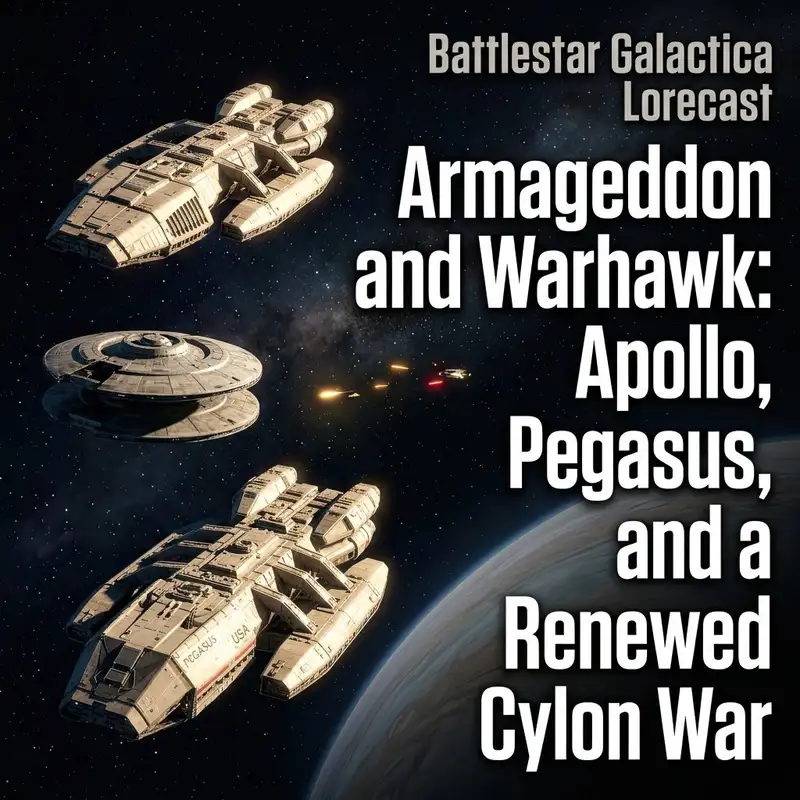
Armageddon and Warhawk: Apollo, Pegasus, and a Renewed Cylon War [Hatch Continuation]
The seizure of the forge ship Hephaestus was more than a mutiny in the middle of a succession dispute. It was an attack on the fleet’s future. Hephaestus carried the workers, tools, furnaces, stored material, and specialized knowledge needed to repair damaged vessels and build new machines of war. During the crisis that followed Commander Adama’s death, newly completed Scarlet-class Vipers were destroyed before they could enter service. People died aboard a ship whose purpose was to keep other people alive. In a mobile refugee civilization, that kind of loss cannot be measured only in wreckage. Every ruined fighter means fewer patrols. Every dead technician means another repair delayed. Every frightened worker means another political wound. Apollo’s first great command problem in Armageddon was therefore not a Cylon attack. It was the discovery that a battlestar could not command a fleet whose labor, industry, and consent had begun to break apart.
Armageddon and its sequel, Warhawk, belong to Richard Hatch and Christopher Golden’s licensed continuation of the original Battlestar Galactica. This is a separate literary future. It continues the classic fleet’s search for the Thirteenth Tribe and Earth after the events of the nineteen seventy-eight series, while bypassing the later future presented in Galactica nineteen eighty. It does not share a timeline with the reimagined series, and it should not be blended with every other novel, comic, game, or adaptation that has used the names Galactica, Apollo, or Pegasus. The practical difference is that these books imagine an older refugee fleet, one that has survived for roughly two decades after its escape from the Twelve Colonies. The exact conversion between a yahren and an Earth year is not firmly established. The strategic reality is clear enough. The original survivors have aged. Their leaders have become legends. Their children have become officers and pilots. And the war they believed they had outrun is beginning again.
The pressure on Hephaestus exposed a problem that had been growing quietly beneath the fleet’s continuing search. Commander Adama had been more than the commanding officer of Galactica. He had been the living connection between the surviving Colonials and the civilization they had lost. His authority rested on rank, experience, military skill, personal sacrifice, and the simple fact that he had held the fleet together through disasters that might have shattered any ordinary political system. When his health failed and he died, the fleet did more than lose a commander. It lost the person who had made military necessity and civilian endurance seem part of the same cause.
Apollo entered that crisis as a lieutenant commander, not yet as the uncontested heir to his father’s position. He possessed battlefield credibility, the respect of veteran pilots, and the confidence that came from years of serving beside Adama. But none of that automatically made him the lawful commander of a scattered people. A fleet can promote an officer quickly. It cannot manufacture legitimacy on the same schedule. The Quorum of Twelve still had a role in recognizing the transfer of authority, and President Tigh represented the civilian side of a political order strained by fear, fatigue, and competing ambitions.
Apollo therefore inherited several burdens at once. He inherited Galactica, still the armed core of the refugee fleet. He inherited the search for a permanent home. He inherited a warrior culture that expected its leaders to fly into danger beside the people they commanded. He inherited Adama’s symbolic place as protector and father figure. Most difficult of all, he inherited a society in which many people could agree that Apollo was capable while still disagreeing over how he should come to power. That distinction would define the early phase of his command. He could issue orders in an emergency. He could direct fighters and defend ships. But tactical command was not the same thing as political authority accepted by the fleet as a whole.
The external danger returned before that question could be settled. Near the planet Ochoa in the Binary Thirteen system, Apollo and Starbuck conducted reconnaissance and found evidence of a Cylon presence. The mission should have been the sort of risk veteran pilots understood well. Reconnaissance is never simply looking. It is an attempt to answer whether a contact is real, hostile, nearby, and relevant before the enemy can decide the same questions about you. Instead, the encounter demonstrated that the Cylons were once again operating in the fleet’s path.
Starbuck was shot down and presumed dead. For the fleet, the loss was military as well as personal. Starbuck was not a replaceable cockpit occupant. He was an experienced combat pilot whose judgment had been shaped by years of fighting, flight operations, and survival. A refugee force can train new pilots, but it cannot accelerate them through the accumulated experience of veterans without paying for that education in risk, accidents, and casualties. The loss of one senior pilot could affect patrol schedules, training standards, squadron confidence, and the willingness of younger aviators to accept an order they did not fully understand.
The Ochoa contact also overturned a strategic assumption. The Colonials had spent years moving through space under the hope, or at least the working belief, that the Cylons were behind them. Now the enemy was operating forward of the fleet. That did not necessarily answer every question about Cylon strength, intentions, or deployment. It did establish that evasion was no longer enough. The fleet had to prepare for a renewed contest of intelligence, maneuver, and force preservation.
Baltar became useful in that effort for reasons that did not make him trusted. His association with the Cylons and the long history of treason surrounding him made him politically toxic. Yet a man with knowledge of the enemy’s methods, habits, and ambitions could still possess operational value. Apollo’s problem was not whether Baltar had become morally uncomplicated. He had not. The problem was whether a commander facing a returning enemy could afford to discard intelligence because its source was compromised. The books do not turn Baltar’s expertise into absolution. They present it as one more reminder that survival often requires using flawed people without forgetting why they are flawed.
Starbuck, however, had not died. Stranded after the crash, he found himself trapped near a damaged Cylon outpost. His survival created a second problem for Apollo. The commander had reason to believe Starbuck might still be alive, but not enough conventional proof to treat the matter as settled. At the same time, Apollo experienced an apparent mental connection with his friend while meditating in Adama’s sanctuary. The experience gave him information and direction, but not the kind of information that could be placed neatly in a tactical report.
The novels treat this as part of a larger spiritual and metaphysical current. Apollo’s perception is connected to Adama’s teachings, the inherited traditions of Kobol, and a reality that does not submit easily to technical explanation. It would be a mistake to turn the event into a new communications system or an undeclared scientific capability. Apollo cannot summon reliable telepathy on demand, assign it to a reconnaissance unit, or replace scouts with meditation. The point is more difficult and more useful. Commanders sometimes receive a warning, an intuition, a fragment of insight, or a conviction that cannot be fully verified at the moment it must be acted upon.
That does not make every instinct wise. Nor does it excuse a commander from seeking evidence. Apollo’s growth lies partly in learning the difference between treating a private experience as absolute truth and allowing it to shape a decision while remaining accountable for the consequences. Starbuck’s survival mattered because it restored a friend and veteran pilot. It also showed Apollo that Adama’s inheritance was not only constitutional and professional. It was spiritual, though not in a way that relieved him of responsibility.
Private conviction could not resolve the crisis engulfing the fleet. Ambassador Puck attempted to force Apollo’s elevation through public agitation, strikes, mutinies, and pressure on the fleet’s civilian institutions. The campaign drew strength from a real condition. Many Colonials wanted stability. Many believed Apollo had earned command. Many feared that delay by the Quorum would leave the fleet leaderless at the moment the Cylons returned. But a justified fear can still be used in destructive ways.
Puck’s movement attempted to make Apollo commander by creating so much unrest that no alternative seemed possible. The attempted separation of Scorpius Ascendant and the seizure of Hephaestus transformed political pressure into a direct threat against fleet cohesion. A civilian ship breaking away could not be reduced to a symbolic protest. Separation could mean lost labor, lost supplies, lost families, and a weakened ability to coordinate defense or execute an emergency withdrawal. The danger increased when the breakaway vessel carried a function the larger fleet could not easily replace.
Hephaestus made that danger visible. Industrial capacity is often discussed as though it were an abstraction, a matter of production figures and warehouse inventories. In a refugee fleet, it is embodied in people working under exhausting conditions with finite tools and material. It is in the technicians who understand an older Viper’s systems, the fabricators who can replace a damaged part, the laborers who move raw material, and the supervisors who decide which need must wait. Destroying Scarlet-class Vipers on the forge ship was not just a setback to an air wing. It was the destruction of future sorties before the aircraft ever reached a launch bay.
The political lesson was equally severe. Puck might claim to be acting for Apollo’s benefit, but no commander can accept power delivered through mutiny without risking the authority he is supposed to restore. If Apollo allowed violence and coercion to decide the succession, he would begin his command indebted to the very forces that had damaged the fleet’s unity. He would be commander in title while the Quorum, the workers, and the ship captains understood that armed pressure had become the real constitution.
Apollo’s eventual elevation to full commander mattered because he accepted formal responsibility rather than merely benefiting from popular acclaim or military necessity. That did not erase the deaths, damage, or bitterness of the crisis. It did establish that the fleet still required a recognized relationship between military power and civilian consent. Apollo could fly a Viper. He could lead a strike. But he could not preserve a civilization by acting as though combat skill alone entitled him to rule it.
His continuing ability to fly remained symbolically important. The commander did not become distant from the risks carried by pilots and crews. He retained a direct connection to the warrior identity that had helped keep the fleet alive. Yet the books steadily redefine what that identity must mean. The right commander is not necessarily the pilot willing to take the greatest personal risk. It is the officer willing to decide when not to spend irreplaceable people and machines for glory, anger, or pride.
With the succession settled, the fleet returned to the larger purpose that had carried it across the years: the search for a world where the Colonials could stop running. An ancient holographic map associated with the lost Kobollian colonies offered a possible route toward the Xerik system. The map did not provide certainty. It did not promise Earth, safety, or a friendly population waiting to receive refugees. It was a piece of inherited knowledge, valuable precisely because the fleet had so little reliable information about the regions ahead.
About half a yahren after the events of Armageddon, Apollo led the fleet toward Xerik. The journey did not reveal Earth. It revealed a region already shaped by conflict. The Colonials encountered the Sky, a telepathic people, and the Chitain, a militant civilization whose political and military ambitions would soon become central to the fleet’s fate. Valor, a Sky warrior known to Apollo, returned with warning of a Chitain attack on a Sky embassy. The warning mattered not only because of its immediate content, but because it challenged the Colonials’ old habit of viewing every unknown power through the lens of Cylon pursuit.
The Sky and the Chitain were more than new species added to a larger map. Their presence changed the strategic environment. The Colonials had entered a theater where local rivalries, alliances, and grievances already existed. A people searching for refuge could become a potential ally, a military asset, a diplomatic burden, or an object of manipulation. The fleet’s commanders had to determine who was dangerous, who was desperate, who was trustworthy, and who might be cooperating with the Cylons. Those questions could not be answered by ship silhouettes alone.
Then came the discovery that transformed the mission. Pegasus had survived.
For years, Pegasus had been presumed destroyed after its separation from Galactica. Sheba had continued to believe that her father, Commander Cain, and the battlestar might still be alive. But belief was not confirmation. Warhawk provides that confirmation by revealing that Cain and Pegasus had established the Poseidon colony. The return of Pegasus restored more than an old friend or a legendary warship. It restored a powerful military institution, a skilled population, and an industrial base that the wandering fleet could scarcely have imagined replacing on its own.
Poseidon possessed factories, foundries, smelters, mining operations, warehouses, and the beginnings of a renewed military capacity. In a society that had spent decades living from accumulated stores, salvage, repair, and adaptation, these were extraordinary achievements. Poseidon represented the possibility that the Colonials could do more than preserve what remained. They might build again.
That promise made the command problem more serious, not less. Cain was still commander of Pegasus, but he was also president of Poseidon. He held military authority over a battlestar and civilian authority over a settlement. In a stable state with courts, elections, established borders, and a functioning civil service, those overlapping roles would already demand scrutiny. In a fragile refugee civilization, they created a rival center of sovereignty.
Cain’s authority was not imaginary. He had led people through survival, settlement, industrial development, and defense. Poseidon’s population had reason to trust the leader who had helped create their home. The colony’s achievements gave Cain practical influence that did not depend on anybody else’s approval. He had ships, production, labor, infrastructure, and a local political base. Apollo could not just issue an order and assume that Cain’s people would see it as legitimate.
Apollo’s own mission carried him toward the Chitain homeworld, Xerik Seven, aboard the battle cruiser Starlight. Starbuck accompanied him, along with Boomer and Gar’Tokk of the Borellian Nomen. Their presence reflected the changing character of the fleet. The Colonials had survived in part because they had accepted help from people who had once been viewed with suspicion or fear. Gar’Tokk’s relationship with Apollo was not an argument that past hostility no longer mattered. It was evidence that necessity had widened the fleet’s definition of who could belong within its struggle.
The delegation was intended as a diplomatic effort, but diplomacy in an unstable theater is always also an intelligence operation. When Apollo and his companions were detained, the mission became an opportunity to observe, question, and discover what official meetings had concealed. They uncovered a hidden Cylon base and evidence of cooperation between the Cylons and the Chitain. This was not just an enemy alliance in the abstract. It meant that the Cylon threat had adapted to the region. The Colonials were no longer dealing with a pursuer operating alone across empty space. They faced an enemy capable of finding local partners, exploiting their fears, and using regional conflict to isolate the fleet.
The intelligence from Xerik Seven changed the urgency of every decision concerning Poseidon. The colony was more than exposed to distant danger. It stood within a contested environment shaped by Chitain power and Cylon involvement. Its industrial value made it attractive. Its military potential made it threatening to anyone who hoped to dominate the region. And its population had built a life under conditions that could not be judged only by the output of its factories.
The most decisive discovery concerned Poseidon’s environment. The colony was productive, defended, and increasingly developed, but its conditions would cause genetic deterioration over generations. The exact mechanisms need not be reduced to a laboratory lecture to understand the strategic result. Poseidon was a demographic trap. A population could remain there, build ships, mine resources, and defend its settlements, while quietly condemning its descendants to an unsustainable future.
Cain resisted the evacuation. His resistance should not be dismissed as simple vanity or insubordination. Poseidon was his command, his political responsibility, and the product of years of sacrifice. Its people were not cargo to be removed from a failed project. They were citizens with homes, work, loyalties, and grief waiting for them if they abandoned the world they had built. Cain also had reason to believe in the military and industrial strength of his settlement. From his perspective, evacuation could look like surrendering a hard-won base because of a danger that would not destroy the colony immediately.
But Cain’s combined authority created a dangerous conflict of interest. As Poseidon’s president, he could argue for the wishes of the colony. As commander of Pegasus, he possessed military power that could obstruct the fleet’s larger decision. The question was not whether Cain had earned the right to speak for Poseidon. He had. The question was whether a local authority could hold the entire Colonial future hostage to local attachment when the evidence showed that remaining would endanger the population’s descendants.
Athena became crucial at this point. While Apollo remained away on his mission, she served as acting fleet commander. Her role demonstrates that the Colonial command structure could not rest only on Apollo’s charisma, Adama’s memory, or Cain’s prestige. A fleet survives through delegated authority, officers who can act under pressure, and a chain of command capable of functioning when the senior commander is absent. Athena supported the evacuation and received authority to arrest Cain if he actively obstructed it.
That was an extraordinary measure, but it reflected an extraordinary problem. The fleet was not deciding a minor administrative dispute. It was deciding whether a colony with real achievements could remain in place despite a long-term threat to its people. Sheba’s support for fleet cohesion mattered for similar reasons. As Cain’s daughter and a senior pilot, she stood close to both the personal and military dimensions of the conflict. Her position underscored that unity did not mean pretending loyalty was painless. It meant accepting that private bonds and local pride could not override the survival of the larger people.
The evacuation decision had to be carried out under combat conditions. Chitain forces attacked with a level of preparation that suggested they had studied Colonial fighter behavior. Their initial advantage could not be reduced to a matter of greater firepower. It came from understanding patterns. Repeated tactics become predictable. Experienced pilots may be bold, skilled, and disciplined, but an enemy that observes their formations, reactions, and attack preferences can turn familiarity into vulnerability.
The Colonial response was adaptation under pressure. Troy and Dalton employed the Duet, a paired-Viper configuration supported by a weapons module. It was a useful improvisation for the battle at hand, not proof that the fleet had suddenly adopted a universal new doctrine. The importance of the Duet was practical. It showed that the Colonials were still experimenting with ways to combine aircraft, weapons, and pilot coordination against an enemy that had begun to anticipate them.
The Chitain offensive threatened more than battlestars. It threatened the evacuation timetable. Civilian movement, industrial withdrawal, and fleet preparation all require time. A successful defensive action was not measured solely by enemy craft destroyed. It was measured by whether transports could load people, whether critical equipment could be moved, whether ships could assemble for departure, and whether the fleet could avoid being divided during the transition. The battle was a fight for an evacuation window.
The Sky altered that balance. Their intervention brought highly maneuverable armor-ships directed through their own telepathic capacities. The Sky’s methods were not Colonial methods, and the Colonials did not suddenly understand every feature of their technology or culture because they fought on the same side for one engagement. What mattered was the coalition effect. The Chitain faced an opponent they had not fully accounted for, while the Colonials gained room to maneuver and concentrate on their immediate objectives.
The battle demanded losses. Captain Hecate was killed. Starbuck and Gar’Tokk suffered severe injuries. Other Colonial and Sky losses were heavy, even if the available account does not support a precise census. These casualties were not background decoration for a victorious assault. They represented experienced fighters, allies, friends, and future capacity removed from a population that had very little capacity to spare. A refugee fleet cannot absorb loss the way a secure state can rotate units, recruit replacements, and draw upon a vast industrial base.
Apollo led the assault against the Chitain mother ship. This was the kind of action that might once have defined heroism in the simplest possible terms: a commander entering the most dangerous part of the fight, striking the enemy’s center of power, and surviving through skill and courage. Warhawk gives the moment greater weight by placing it within a larger mission. Apollo’s purpose was not to prove that he was worthy of Adama’s name. It was to make the evacuation possible.
The assault, supported by the wider Colonial and Sky effort, defeated or destroyed the Chitain dreadnought. In the immediate engagement, it was a major success. A powerful enemy formation had been stopped. Across the wider mission, it created the time needed to continue the evacuation and gather the fleet for departure. In broader terms, however, it solved far less than it seemed to solve in the moment. The evidence of Cylon-Chitain cooperation remained. The Cylons had not been eliminated. The Colonials had exposed a hostile alignment in the Xerik region, but exposure is not the same as defeat.
The civilian outcome was even more complicated. Poseidon had to be abandoned not because its people had failed, but because remaining would have bound them to a future of genetic deterioration. The evacuation saved lives in the long term while demanding immediate loss: homes left behind, workplaces dismantled or abandoned, institutions uprooted, and a hard-won sense of permanence destroyed. A commander may be correct and still ask people to surrender something irreplaceable.
The confrontation between Apollo and Cain therefore revealed the difference between power and legitimacy. Cain had power: Pegasus, Poseidon, personnel, industrial resources, and a political constituency. Apollo had fleet command, Quorum-backed authority, and responsibility for a larger population. Neither man’s position was meaningless. But only Apollo’s command could integrate the requirements of every ship, colony, and future generation. The evacuation required Cain’s assets, Athena’s discipline, Sheba’s support, civilian cooperation, and the willingness of Poseidon’s people to accept that their local success could not become their permanent destiny.
Even after the Chitain dreadnought was defeated, the fleet did not receive the luxury of orderly recovery. Three Cylon basestars arrived as the Colonials prepared to escape. The timing mattered. Fleets are most vulnerable during transition. Ships are moving, loading, repairing, tending wounded, regrouping fighters, and attempting to establish common navigation and departure plans. An enemy appearing at that moment can turn a tactical victory into a disaster before the victors have time to exploit it.
The answer was Quantum Shift-Effect technology, commonly called QSE. This capability allowed the fleet to phase or cloak itself outside normal space-time, creating an avenue of escape beyond ordinary maneuver. It was a remarkable advantage, but it was not magic. The technology had to be integrated across vessels with different systems and different degrees of compatibility. It required technical expertise, coordination, and time, three resources that combat rarely provides in generous supply.
At first, Pegasus, Daedelus, and three Poseidon-built battle cruisers were at risk of being left behind because they had not yet been successfully connected to the QSE system. This was the final and perhaps clearest proof of the episode’s central lesson. Advanced technology can multiply survival options, but it can also reveal the danger of unequal integration. A fleet is not safe merely because its flagship can escape. If essential ships, civilian populations, combat forces, or industrial assets cannot come with it, the fleet may survive physically while losing the capacity to remain a civilization.
Plutarch and Omega succeeded in bringing the endangered vessels into the QSE network. Their achievement was not the kind of victory usually celebrated in legends of fighter aces and battlestar commanders. It was technical work done under pressure, work that depended on understanding systems, overcoming incompatibility, and finishing before the enemy could close the trap. Yet it mattered as much as the battle. The survival of Pegasus and the Poseidon-built ships preserved military capability, industrial knowledge, crews, families, and the possibility of rebuilding.
The fleet escaped together. That word, together, is the real achievement of Warhawk. Galactica did not flee alone. Apollo did not save only the ship that carried his command flag. Pegasus was not abandoned because Cain had challenged fleet authority. Poseidon’s people were not written off because their colony had become untenable. The ships least easily integrated into the new technology were not sacrificed for the convenience of the ones already prepared to depart.
The escape did not end the renewed war. It only prevented the Cylons from turning the Xerik crisis into another annihilation. The final revelation deepened the threat. Lucifer heard the Imperious Leader addressed as Iblis, strongly linking the Cylon leadership to the supernatural adversary who had already returned to trouble the Colonials. The connection is unmistakably ominous, but its exact nature remains unresolved. The books do not provide a clean technical explanation of Iblis, the Light Ships, or the larger powers moving through the story. They establish consequences more clearly than mechanisms.
Armageddon and Warhawk transform Apollo not by making him a copy of Adama, nor by proving that he can outfight Cain in a contest of personal authority. He becomes commander by accepting that Galactica’s survival is not the same as the fleet’s survival, and the fleet’s survival is not the same as the survival of a people. He must preserve fighters, but also the workers who build them. He must respect civilian institutions, even when they are slow and divided. He must use military power without allowing it to become the only source of political legitimacy. He must abandon a colony that has become a generational trap, while carrying its people and capabilities forward.
The reunion with Pegasus strengthens the Colonials only when Cain’s local power, Apollo’s formal command, Athena’s delegated authority, and Poseidon’s civilian needs are forced into a single strategic purpose. The renewed Cylon war is not won at Xerik. It is survived because Apollo learns that command is the obligation to carry the whole civilization forward, including the ships, people, and future generations most likely to be left behind.