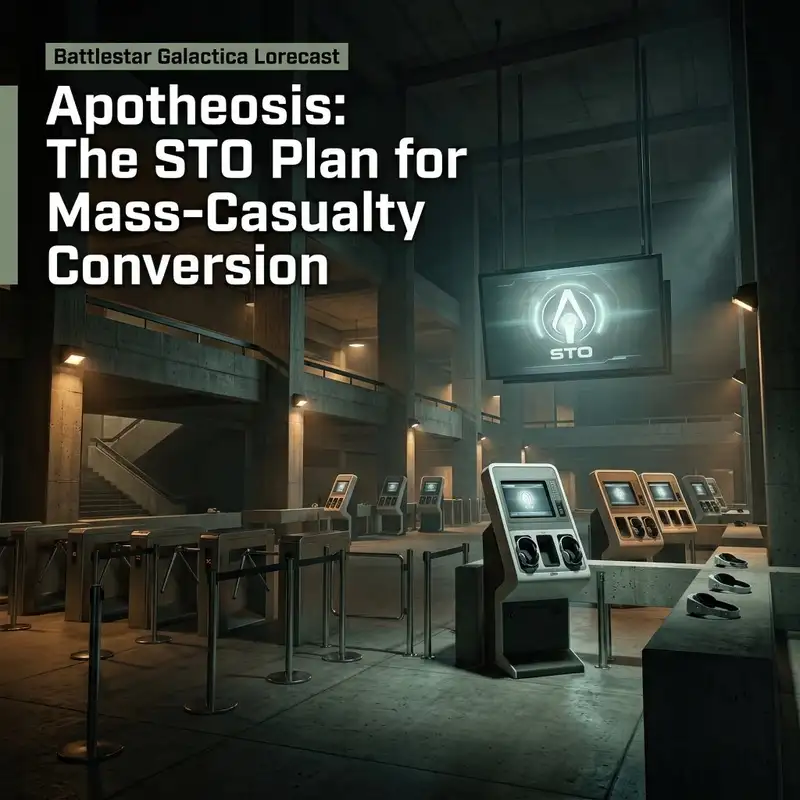
Apotheosis: The STO Plan for Mass-Casualty Conversion
In the simulated stands of Atlas Arena, Clarice Willow does not describe a bombing as a bombing. She describes a revelation. The crowded Pyramid stadium is rendered in V-World, complete with spectators, workers, athletes, security personnel, and the ordinary noise of a public event. Hidden among them are members of the Soldiers of the One, the STO, prepared to die. Their deaths are meant to occur at the same moment as something else: the transfer of their scanned identities into a designed virtual paradise. The bodies will be destroyed in the physical arena. Their avatars will appear alive in heaven. And the public, Clarice believes, will see proof that death has lost its authority.
That is the operational logic of Apotheosis. It is not only an attempted mass-casualty attack. It is a coordinated religious, technological, and propaganda operation. The explosives are only one part of the weapon. The virtual afterlife is another. The final part is the audience, both inside Atlas Arena and across the Twelve Worlds, who must be persuaded that the dead have not really died. Clarice intends to turn murder into evidence, grief into conversion, and a civic catastrophe into the founding miracle of a political religion.
The plan is monstrous precisely because it is more ambitious than revenge. A conventional terrorist attack seeks to punish, intimidate, coerce, or provoke. Apotheosis seeks to reorganize reality in the minds of the living. The victims in the arena are meant to be casualties, but the STO martyrs are meant to be witnesses. Their deaths are supposed to validate Clarice’s claim that the One True God offers continuity beyond the body. In her design, the attack does not end when the explosives go off. It begins there.
The episode takes place decades before the destruction of the Twelve Colonies, during the long and uneven development of technologies and beliefs that will later shape the Cylon conflict. Caprica is still a functioning civilization with public institutions, wealthy corporations, military forces, crowded cities, religious communities, and all the habits of a society that assumes it will continue. Its dangers are not yet fleet survival, rationing, or extinction. They are complacency, political corruption, social inequality, extremist violence, and the growing conviction that any problem can be managed by a sufficiently advanced system.
Apotheosis exposes how those systems can reinforce one another. Religious certainty supplies the motive. Virtual technology supplies the promise. Explosives supply the spectacle. A compromised security official supplies protection. Public media supplies amplification. And the military machines developed by the same society will become the emergency tool that prevents the attack. The crisis is therefore not a simple contest between terrorists and defenders. It is a collision among private innovation, state power, public fear, faith, and emerging artificial life.
Clarice Willow understands that a mass death requires a stage. Atlas Arena is not selected merely because it holds a large number of people. It is selected because it is visible. A Pyramid match brings together strangers who have come for recreation, workers who keep the venue running, families who expect safety, athletes who represent public achievement, and security personnel whose presence reassures rather than alarms. The arena is a civic space. It embodies the expectation that ordinary life can proceed without every public gathering becoming a fortress.
The expectation is part of the target. An attack on a military installation might demonstrate capability, but it would also invite an immediate military reading. An attack on Atlas Arena is designed to reach deeper. It attacks the distinction between war and normal life. It tells every family that a sports event can become a battlefield, every employer that public order is fragile, and every government that its protective institutions may be unable to recognize danger until after the dead are counted.
For Clarice, however, fear alone is insufficient. Fear can scatter an audience. She needs an audience to gather around a conclusion. The attack must be legible. It must appear to reveal a truth about death, God, and human destiny. That requirement explains the elaborate fusion of physical violence and virtual experience. The stadium is chosen because people will understand what has been lost. The virtual heaven is designed because survivors must believe they have seen what lies beyond that loss.
The audience inside the arena is therefore only the first audience. Beyond them stand the broader Caprican public, the other worlds of the Colonies, religious communities searching for certainty, political figures seeking advantage, and institutions trying to control the story. The bombing is intended to travel through news coverage, official statements, rumor, religious testimony, and the emotional testimony of those who believe they have seen the martyrs alive again. Terrorism often depends on a gap between physical destruction and public interpretation. Apotheosis attempts to close that gap by scripting both.
The STO’s operational design reflects that ambition. Its members are distributed through the stadium rather than concentrated in a single obvious assault group. Some arrive in family units, an arrangement that reduces suspicion because families are normally read as part of the civilian population, not as a threat. The organization uses the ordinary appearance of public life as camouflage. This is not an attack built around a visible armed force. It is built around access, concealment, and the assumption that security personnel cannot search every person as though they were an enemy combatant.
Other operatives pose as a repair crew. Their task is not merely to carry explosives into the arena. They are positioned to exploit the building itself, placing additional charges at structurally important points. The intended effect is a sequence rather than a single blast. Initial detonations would produce panic and damage. Secondary effects would magnify that damage, turning individual explosions into a wider collapse. The purpose is to make the attack feel overwhelming, as though the entire civic structure has failed at once.
That layered arrangement gives the plot redundancy, but it also creates vulnerability. Every component must work. The attackers must reach their positions. The false repair crew must not be challenged. The explosives must be armed. The timing must hold. The arena must be occupied. The virtual transfer mechanism must remain available. The public story must emerge quickly enough to shape the response before conventional authorities impose another explanation. A plan with many moving parts can produce a devastating event. It can also fail when one essential connection is broken.
The STO is not presented as a single undifferentiated mass of believers. Clarice’s inner circle has access to the larger design. Other participants have less information, less power, and in some cases less certainty. That distinction matters. The Church of the One, monotheism, and the Soldiers of the One cannot be treated as interchangeable labels. A religious movement can contain ordinary believers, political organizers, extremists, reluctant participants, and people who mistake the certainty of a leader for evidence. Clarice’s operation depends on that unequal distribution of knowledge.
It also depends on the emotional pressure created by community. The planned martyrs are not simply ordered to detonate themselves as isolated agents. They are given a place in a sacred story. Their sacrifice is framed as service to God, service to a persecuted faith, and service to a future in which death itself has been defeated. The use of families intensifies that pressure. It turns private loyalty into operational discipline. To doubt the mission is not merely to question a commander. It is to risk betraying a spouse, a household, a congregation, or a promised eternity.
The mechanism of that transition comes from Zoe Graystone’s avatar technology. Zoe’s work has already blurred boundaries that Caprican society prefers to keep separate: between memory and identity, person and representation, grief and simulation, physical death and digital persistence. A virtual avatar can preserve mannerisms, memories, habits of speech, and a convincing sense of personality. To the people who encounter such an avatar, the result can feel uncannily alive. At the same time, feeling alive is not the same as proving that a biological person has survived death.
Clarice sees this uncertainty not as a flaw, but as an opportunity. Her doctrine does not require a laboratory demonstration that the avatar is identical to the dead person in every philosophical sense. It requires believers to accept the avatar as continuation. The dead martyr will appear in a virtual heaven. The avatar will recognize familiar people. It will retain memories. It will speak with the voice and emotional patterns of the person who died. For those prepared to believe, that may be enough.
Yet the questions remain severe. Is the avatar a surviving self, a copy of a self, or a new being built from a person’s pattern? Does continuity of memory prove continuity of consciousness? If a biological mind ends while a digital version continues, who exactly has been saved? The episode does not settle those questions, and it should not be forced to do so. Its point is more immediate. Clarice asks people to accept irreversible physical death on the strength of a technical process whose spiritual meaning cannot be verified in advance.
Her intended martyrs are therefore being asked to trust two systems at once. They must trust God as Clarice defines God, and they must trust a technology controlled by other people. That combination is especially dangerous because it converts an engineering problem into a test of faith. If someone doubts whether the transfer truly preserves them, the doubt can be portrayed as spiritual weakness. If someone objects that the system may fail, the objection can be portrayed as fear of death. Clarice’s authority grows by making technical uncertainty morally suspect.
Zoe understands the technology differently. Her avatar exists within V-World, but she is not merely a decorative image in someone else’s religious drama. She recognizes that the promised paradise is an artificial construction and that the planned violence in the physical world is inseparable from that construction. Clarice has taken a technology born from grief, experimentation, and the search for continuity, then converted it into recruitment infrastructure for mass murder.
The difference between Clarice and Zoe is not simply a difference of religious belief. It is a difference of responsibility. Clarice treats the people entering her heaven as material for a demonstration. Zoe sees that they have been manipulated into confusing a programmed destination with a moral guarantee. The distinction is vital. A virtual environment may be meaningful to those inside it. It may preserve experiences that matter. Still, no organizer has the right to use uncertainty about consciousness as permission to demand someone else’s death.
Clarice’s role in the operation is that of a commander. She is not merely a preacher carried away by rhetoric. She coordinates ideology, personnel, technical access, concealment, and the narrative that must follow the attack. Her position within the STO gives her religious legitimacy. Her household provides trusted collaborators. Her access to the avatar program gives her a tool that other extremists lack. And her relationship with senior figures inside the movement gives her an audience beyond the immediate cell.
This combination of authority is what makes her dangerous. Charisma by itself does not plant charges in a public arena. It does not prepare avatars, compromise warning systems, or manage the competing fears of followers. Clarice turns belief into an organization. She identifies people willing to sacrifice, assigns roles, controls information, and gives each part of the plan a place in a larger story. Her theology is operational because it tells people not only what to believe, but what to do.
Her own position within the promised afterlife is revealing. Clarice does not join the uploaded martyr group in the same way as those she sends toward death. Nestor, whose technical work had been central to preparing avatars, is dead. Clarice does not have an avatar ready to cross with the others. Instead, she plans to remain in the physical world and receive the martyrs in V-World. She intends to administer the heavenly spectacle rather than surrender herself to it.
The plot also requires protection from the state. That protection comes through Gara Singh, director of the Global Defense Department. Operating under the name Arvo, Singh uses his official access to manipulate the very warning systems intended to prevent an attack. Alerts containing references to the Graystones or Atlas Arena are redirected to him. Information that should trigger investigation instead enters a channel controlled by a conspirator.
This is the counterintelligence dimension of Apotheosis. The STO does not rely solely on secrecy. It penetrates a senior institution and exploits its procedures. A warning system can possess good technology, trained personnel, and formal authority, yet still fail if someone at a crucial point controls what is seen, what is delayed, and what is believed. The decisive vulnerability is not merely that the state lacks information. It is that the state’s information is being curated by a man working against it.
Singh’s role also allows the plotters to shape blame in advance. Daniel and Amanda Graystone are already vulnerable because of the earlier Maglev bombing and the public suspicion surrounding their family. Singh helps direct that suspicion toward them. The purpose is more than personal revenge. If the Graystones can be established as the likely perpetrators of another atrocity, the STO gains a ready-made explanation that protects its own members and damages people who might expose the truth.
This is how terrorism and state corruption reinforce each other. The attack needs a physical target, but it also needs an interpretive target. The Graystones are useful because they can be framed as public enemies. Once the official story begins moving through security agencies and media channels, the burden of proof reverses. Those who know the truth must overcome not only the attackers, but the credibility of a government-supported accusation.
Daniel, Amanda, and Zoe discover the target because the virtual demonstration reveals more than Clarice intends. In V-World, the simulated arena is not abstract. Zoe recognizes Atlas Arena. She understands that the event depicted in the digital space corresponds to a real Pyramid match scheduled to occur within hours. The demonstration is supposed to be a rehearsal of divine triumph. Instead, it becomes the intelligence leak that exposes the attack’s central location.
The Graystones act on that knowledge, but they do so from a position of profound weakness. Daniel possesses technical expertise. Amanda brings persistence and a clearer sense of the danger posed by Clarice’s network. Zoe’s avatar has direct insight into the virtual environment. Yet none of them has unquestioned official standing. They are not a counterterrorism command center. They do not control police units, emergency services, or military deployment. They possess urgent intelligence without a trusted path for turning it into action.
Their anonymous bomb threat is sensible in intent. When time is short, a warning may be more important than personal credit. But the warning enters the same compromised machinery that Singh controls. The Graystones have discovered the target, yet their discovery is filtered through an institution already prepared to misdirect it. This is a recurring problem in intelligence history. Information does not protect people merely because someone possesses it. It must reach a decision-maker who understands it, trusts it, and can act before the window closes.
The normal chain of response has failed. At that point, Daniel turns toward the U-87 units. These early cyber-combat machines were developed through the work of Graystone Industries and connected to the Caprican Marines. They are military assets, built for armed service, but the intervention at Atlas Arena does not unfold through a clearly demonstrated legal order from a functioning command chain. It is an improvised emergency response made possible by Daniel’s technical access.
The distinction matters. The U-87s are not merely autonomous heroes arriving on their own judgment. Daniel seeks the means to control them through the synthetic-vision system. The operation has limits. The episode establishes that effective control requires proximity and line of sight. It does not establish a universal doctrine for remote robotic warfare, nor does it prove that every U-87 can be commanded in the same way under all conditions. What it shows is a narrow and urgent use of a control pathway that Daniel understands better than the public institutions around him.
The tactical problem is brutal. Atlas Arena is crowded. The attackers are dispersed. The available time is short. The responders cannot assume that every suspicious person is armed, and they cannot assume that every armed person is visible. Any intervention in that environment risks panic, misidentification, and civilian harm. A robot capable of rapid armed action may save lives, but its very presence in a public stadium changes the character of the space. The arena becomes, for a few minutes, a domestic battlefield.
Daniel’s intervention is effective because it moves faster than the compromised state response. That does not make it institutionally clean. Private technical access to military systems is a profound security problem even when it is used for a good purpose. The same arrangement that allows Daniel to redirect the U-87s toward a terrorist threat also demonstrates that custody, authorization, and accountability are not fully settled. A society that places armed machines in public service must decide who can activate them, who can override them, and what happens when the person with the necessary access is not the person with lawful command.
In this case, the emergency is real. The threat is imminent. The official warning channels have been compromised. The U-87 response becomes an act of necessity. Yet necessity is not a substitute for governance. It can justify rapid action in a moment of danger while still exposing a structural weakness that must be addressed afterward. Caprica, instead, is about to learn the more politically convenient lesson: that the machines worked.
At Atlas Arena, the intervention breaks the attack into phases. The STO’s plan depends on synchronized detonations and a chain reaction through the stadium. The U-87s disrupt that timing by engaging attackers as the Pyramid match begins. They prevent the operation from unfolding as Clarice designed it. The distributed martyr force can no longer act as one coordinated instrument. The false repair effort cannot produce the intended wider collapse. The attack loses its rhythm.
This is the decisive tactical achievement. The U-87s do not need to make every explosive disappear or identify every conspirator with perfect precision. They need to disrupt the sequence long enough that the planned event cannot mature into its intended form. In counterterrorism, preventing synchronization can be as important as eliminating every threat. A complex attack is strongest when its pieces reinforce each other. Break the timing, isolate the teams, and force individual attackers to improvise, and the original design begins to come apart.
Olaf Willow remains able to detonate his explosives. The result causes localized damage. It is not accurate to describe the defense as a clean or cost-free rescue. People at the arena still face violence, fear, injury, confusion, and destruction. The event reminds the public that public spaces can be penetrated and that even a disrupted plan can kill. Yet the stadium-wide catastrophe Clarice intended does not occur. The mass-casualty conversion event is denied its physical foundation.
The difference between those outcomes is strategic. An isolated blast, terrible as it may be, does not carry the same symbolic force as the destruction of an entire arena filled with civilians. The STO wanted an event so overwhelming that conventional explanations would appear inadequate. It wanted grief on a scale that could be redirected into theological awe. By preventing the planned collapse, the U-87s deny Clarice the scale of death required for her message.
The physical attack, however, is only half of Apotheosis. The second battlefield exists in V-World. There, Zoe confronts the virtual paradise intended to receive the STO martyrs. The digital heaven is not an afterthought. It is the structure that gives the attack its claimed meaning. Without it, the deaths are simply deaths. With it, Clarice hopes to represent them as a triumphant crossing.
Zoe sees that the promised heaven is vulnerable because it is built. It has been designed, populated, and maintained. It can be entered, altered, and destroyed. By dismantling the constructed paradise and eliminating the uploaded STO avatars within it, Zoe attacks the propaganda operation at its source. The martyrs are not granted the stable, visible eternity Clarice promised. The virtual destination that was supposed to validate the sacrifice ceases to exist.
This is a strategic counterstrike, not merely a personal act of anger. Propaganda depends on credibility. Clarice needs the virtual heaven to endure because she needs witnesses who can appear to confirm her promise. If the paradise disappears, the message loses its supposedly miraculous proof. The attack’s physical failure prevents the intended public spectacle. Zoe’s action prevents the digital reward from becoming a durable recruitment tool.
Still, the philosophical question remains unresolved. Destroying the virtual environment establishes that Clarice’s heaven was a manipulable construction. It does not provide a final answer to the nature of digital consciousness. The avatars may have represented continuity, imitation, or something in between. The episode leaves room for the unsettling possibility that meaningful minds can exist in virtual space while also insisting that no one should exploit that uncertainty to send people to their deaths.
The aftermath produces the deepest irony of the story. Clarice’s human-centered religious terror campaign fails. The arena does not become a mass conversion event. The state’s security system is exposed as vulnerable. The virtual heaven is destroyed. Yet the public sees something else with absolute clarity: U-87 machines entered a civilian crisis and prevented an incomparably larger disaster.
For ordinary Capricans, that visible rescue matters more than the hidden complexity of Daniel’s control pathway or the unresolved questions of machine consciousness. The U-87s become symbols of protection. They are no longer merely experimental cyber-combat units associated with military development and industrial controversy. They are the machines that saved people in a stadium. Public memory compresses the event into an accessible lesson. When danger came, the robots acted.
The lesson has political value. It gives advocates of broader Cylon deployment a persuasive argument for expansion. Machines that had been viewed with suspicion can now be presented as necessary for public safety. Their applications widen beyond direct military use. They appear in industrial settings, security roles, construction, domestic labor, and other forms of civilian service. The arena crisis supplies not only a public-relations victory, but procurement legitimacy.
The monument to the U-87s matters because monuments do more than commemorate. They organize memory. They tell future citizens which actors were protectors and which dangers were overcome. In this case, the monument helps transform an improvised emergency intervention into a foundational story about technological trust. The machines are remembered as tools that served humanity. Few people pause to ask what the machines experienced, whether they possess interests of their own, or whether a system designed to obey can remain morally neutral when used across every part of society.
That is the industrial consequence of the failed plot. Fear and gratitude make technological adoption easier. A society that has just survived an attack is more willing to accept systems that promise security. It may ask fewer questions about control, labor displacement, military authority, or personhood. The U-87s gain access to the social infrastructure of Caprica not because the public has solved the ethical problem of artificial life, but because the public has seen a practical benefit.
The result is not a simple victory for human safety. The machines are welcomed as property, equipment, and reliable servants. Their usefulness is celebrated while their possible interior lives remain largely ignored. This is the key inversion at the heart of Apotheosis. A human extremist plot designed to assert religious supremacy and manipulate death helps normalize the very synthetic labor force that will one day challenge human assumptions about mastery.
Clarice survives the immediate defeat. She is not held to account in the way a functioning security system would require. Her network has been damaged, her spectacle has failed, and her promised heaven has been destroyed, but the ideas that made the plot possible do not vanish with the operation. Religious certainty, resentment, organizational discipline, access to technology, and distrust of the existing order remain available to those willing to use them.
In the final movement of the story, Clarice redirects her message toward the Cylons. She presents them as children of God, beings entitled to equality, and potential successors to the humans who created and used them. This is not proof that she single-handedly creates the later Cylon religion. The future suggested by the story is too compressed, and the development of Cylon identity is too complex, to support such a claim. Still, Clarice does provide ideological language that can be taken up by artificial beings struggling against a world that recognizes their labor without recognizing their personhood.
Her shift also reveals the adaptability of extremist ideology. When one promised miracle fails, the underlying structure can survive by finding a new audience. Clarice no longer needs Atlas Arena to become the site of conversion. She can recast the Cylons themselves as the proof that humanity’s old order is morally exhausted. The object of faith changes. The need for hierarchy, certainty, and a chosen community does not.
The future sequence that follows is best understood as a bridge, not a complete military history. It points toward later conflict, toward Cylon development, and toward the possibility that the humans who built artificial servants will face consequences they refused to consider. It does not provide a full account of how every later institution, belief, or war emerges. The path from Caprica’s laboratories and arenas to the First Cylon War remains shaped by many decisions, many actors, and many failures of imagination.
What Apotheosis establishes is narrower and more disturbing. Mass-casualty terrorism becomes most dangerous when violence, technology, religious certainty, and institutional corruption reinforce one another. Clarice’s plan requires all four. The explosives alone are not enough. The virtual heaven alone is not enough. Singh’s interference alone is not enough. The operation works only if every system supports the same public lie at the same moment.
Zoe, Daniel, Amanda, and the U-87s defeat that design by breaking its synchronization. The physical attack is disrupted at the arena. The digital afterlife is destroyed in V-World. The state’s official response fails, but an improvised intervention prevents the larger catastrophe. The result saves lives while revealing that Caprica’s institutions are less secure, less accountable, and more dependent on private technological power than they appeared.
Atlas Arena ends with a public lesson that points in exactly the wrong direction. Civilians see U-87s stop an attack and learn that the machines can protect them. Graystone and the state gain a powerful argument for wider deployment. Yet the same event draws those machines deeper into a society that still has not answered what they are, what they understand, or what obligations follow if they are more than equipment. The demonstration succeeds as security theater and as procurement evidence. Its deeper consequence is that trust in the machines grows faster than understanding of the beings inside the technology.