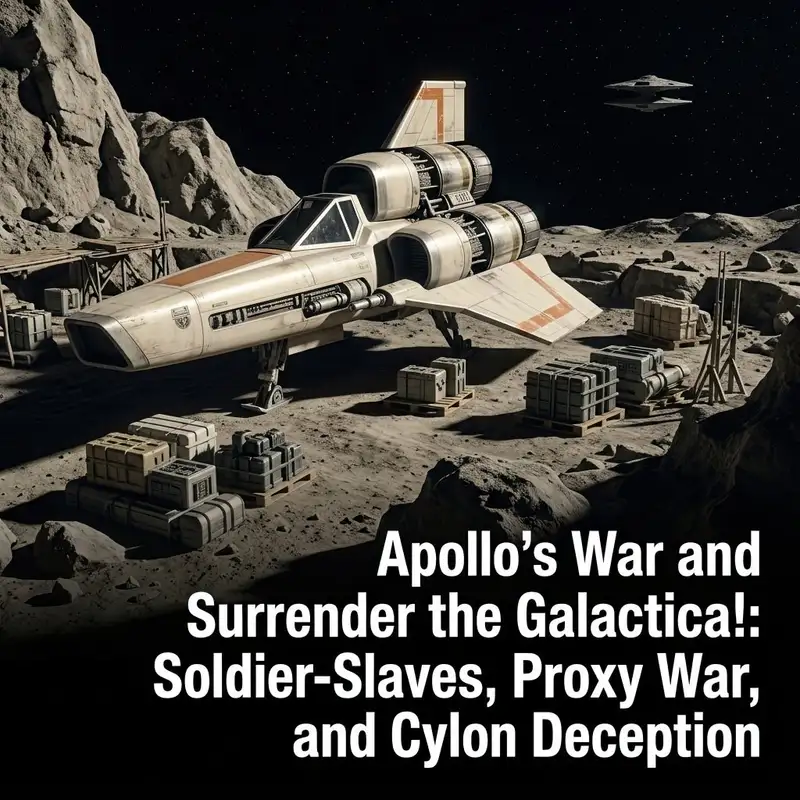
Apollo’s War and Surrender the Galactica!: Soldier-Slaves, Proxy War, and Cylon Deception [Classic Novels]
The explosions have already done their work. In Galactica’s landing-bay and engine sections, fire, wreckage, and trapped personnel have turned a warship into a damage-control problem. The battlestar is still armed. Its commander is still on the bridge. Its pilots are still available. Yet the systems that connect those people to combat power have been broken at the worst possible moment. Launch operations are compromised. Maneuver is restricted. Cylon forces are closing. A ship built to defend a refugee fleet now faces the prospect of being unable to put its normal fighter strength into space.
That crisis is the climax of Surrender the Galactica!, the final Berkley Books novel published after Apollo’s War. Together, these two late-nineteen-eighties stories form a distinct literary branch related to the original Battlestar Galactica, but separate from the television series, Galactica nineteen eighty, Richard Hatch’s continuation novels, later comics, games, and the reimagined continuity. Their central military question goes beyond whether Galactica can destroy Cylons. It is whether people can retain the power to choose when war turns bodies, memories, routine access, and fear into weapons.
Apollo’s War presents coercion openly. Captured people are turned into soldiers for a conflict whose original political purpose has disappeared. Surrender the Galactica! presents coercion in disguise. A Cylon commander uses altered faces, manipulated memory, civilian cover, sabotage, and psychological pressure to make Galactica destroy its own readiness from within. One story takes place on a planet where captivity is obvious. The other takes place aboard a battlestar where ordinary social life becomes the access route for attack. In both cases, the military problem begins when people lose meaningful control over their own actions.
The Berkley fleet is larger in conception than the fleet most viewers remember from the original television series. Apollo’s War describes a refugee population in the hundreds of thousands. That figure belongs to these novels alone. It should not be carried backward into the televised continuity as if the two sources shared a single census. Within this literary branch, though, the scale matters. A fleet of that size cannot live indefinitely on inherited supplies. It requires fuel, food, replacement material, maintenance labor, and places where exhausted people can pause without becoming easy targets.
The voyage has already been long. The fleet has endured diversions, shortages, and the familiar strategic burden of travel toward Earth without a secure industrial base behind it. A battlestar can protect a convoy, but it cannot manufacture an entire civilization from its flight decks and engine rooms. Every supply opportunity therefore carries risk. Every landing party potentially exposes trained people, aircraft, and intelligence to loss. The need for resources pushes the fleet outward. The need for security pulls it inward. Neither instinct can be ignored for long.
Apollo enters Apollo’s War not only as a famous warrior but as Galactica’s flight coordinator. That assignment gives him responsibility for something larger than his own cockpit. Fighter operations depend on schedules, launch readiness, pilot availability, maintenance, and the ability to use scarce personnel without exhausting them. His removal from the ship is therefore not just a personal loss. It creates an operational absence in a fleet that has few people who can be replaced easily.
It is also a family strain. Boxey has already grown up in a world where Apollo’s missions repeatedly take him away into danger. For adults in the fleet, service can be described in terms of duty, command, and survival. For a child, the same pattern can look like a series of departures that may one day become permanent. The novels do not treat that fear as a minor domestic inconvenience. It is part of the human cost of keeping a fleet alive under pursuit.
Apollo, Sheba, and Croft descend to the planet Yevra in connection with the fleet’s need for supplies. Croft, a Scorpian and former prison-barge commander, has established himself through earlier courage and now operates within Apollo’s group as someone whose experience is practical rather than ornamental. Sheba remains a capable pilot and field partner. They are precisely the sort of personnel a refugee fleet cannot afford to lose. Their mission shows the recurring dilemma of expeditionary survival. The skills needed to investigate a possible resource site are the same skills most damaging to lose if the site becomes hostile.
Yevra appears to offer opportunity. Instead, it becomes a manpower trap. Apollo, Sheba, and Croft are captured and drawn into a planetary war between the Army of the Rightful Destiny and the Pelters. The names suggest ideological certainty. The reality is emptier. The conflict has continued so long that its original cause has been forgotten. The war survives not because either side can still articulate a coherent political aim, but because institutions have learned how to feed more people into the fighting.
A force held together by coercion can still be dangerous. It can shoot, move, occupy ground, obey immediate commands, and overwhelm another unwilling force. But it lacks the deeper qualities that make military organizations durable. Its members have no reliable loyalty to the mission. They have every incentive to escape, deceive their captors, protect private relationships, or wait for the moment when the control system falters. Commanders may mistake pain-induced obedience for discipline. In doing so, they build an army that functions only as long as coercion remains physically and psychologically unbroken.
The instruments of control on Yevra are direct. Belts and sweatbands can inflict severe pain. The captives are made to understand that obedience is the practical condition of survival. The book is clearer about the effect of these devices than their technical design, and that distinction matters. What matters militarily is not an engineering specification. It is the relationship between command and captive. The devices turn every order into a threat. They attempt to replace judgment with reflex.
The Pelters use another form of control as well. When Apollo falls into their hands, they remove the restraints imposed by one side only to replace them with their own. They drug him through food and drink, clouding his ability to think and making his apparent choices less than voluntary. Their objective is not to win Apollo’s loyalty. It is to use his training, reputation, and access as a weapon against the Army of the Rightful Destiny’s leaders. The change of captor does not restore freedom. It merely changes the insignia attached to the controller.
That helps explain why Apollo’s position is more serious than that of an ordinary prisoner of war. He is not just confined. He is assigned an identity that serves the enemy’s battlefield needs. He is told whom to fight, whom to kill, and what his role is supposed to mean. Yet the novel refuses to present that imposed role as his true allegiance. The restraints can shape his behavior. Drugs can narrow his judgment. They cannot fully erase the fact that Apollo belongs to a different community and carries obligations that existed before Yevra seized him.
Xiomara makes that point in personal terms. She is a young woman marked by the war and compelled into its service, but she is not defined by the role assigned to her. Her prior life, missing husband, and unresolved loyalties remain present beneath the soldier identity imposed on her. In a conventional adventure story, captivity often becomes a shortcut to romance. A shared danger produces attraction, rescue settles the future, and the survivor becomes a reward for the hero. Apollo’s War takes a more difficult path. Xiomara’s history cannot be repaired by Apollo’s sympathy or courage.
The Yevran system depends on reducing people to usable categories. Captive. Fighter. Asset. Target. Xiomara’s continued attachment to the person she lost is a refusal of that reduction. It also exposes the strategic poverty of the war around her. A command structure that can force a person to carry a weapon cannot compel her to forget whom she loved, what she lost, or why the imposed cause remains alien. The war can occupy bodies. It cannot make the captors the authors of every memory.
Sarge enters this system as a more complicated figure than a simple enemy commander. A reptilian officer aligned with the Yevran war machine, he trains Apollo, Sheba, Croft, and Xiomara into an elite fighting unit. At first, he is an instrument of the very structure Apollo must resist. He teaches captives how to survive and fight within a system designed to consume them. That makes him responsible for sustaining the war. It also gives him a closer view of the captives as individuals than the distant authorities who treat them as replaceable manpower.
Apollo’s early objective is survival. He must assess the restraints, understand the local command structure, preserve his companions, and avoid becoming so useful that escape becomes impossible. But survival alone does not answer the larger problem. If Apollo escapes by himself, Yevra still captures the next group. If his unit wins a battle for one faction, the other faction will simply recruit or seize more victims. The war can continue as long as the machinery of coercion remains intact.
His thinking therefore shifts. He begins to recognize that the enemy is not only the soldier firing from the other side. It is the system that makes soldiers out of captives and hides the war’s lack of purpose behind perpetual mobilization. That realization changes his use of leadership. The point is no longer merely to command people effectively in combat. It is to restore enough trust among people under control that they can act against the institutions controlling them.
The Pelters believe they have solved this problem when they capture Apollo. They have obtained a trained Colonial officer and placed him under their own restraints. Through drugs and conditioning, they direct him toward assassination. The plan is tactically intelligent in a narrow sense. Apollo’s skills, familiarity with military risk, and ability to move through dangerous situations make him valuable. But the plan repeats the same error made by the Army of the Rightful Destiny. The Pelters confuse possession of a person with possession of that person’s will.
The decisive encounter comes when Apollo meets Croft in battle. Both men are constrained by systems they did not choose. Both are pushed toward actions neither would freely take. Yet recognition survives. Before either can entirely reclaim control as a soldier, they recognize one another as people with a shared past and a shared enemy behind the immediate battlefield lines. That recognition is the first breach in the structure of command imposed on them.
Sarge intervenes during the confrontation. Apollo shoots him, and Croft removes Apollo’s controller. The novel does not require an elaborate technical explanation for the device’s defeat. Its importance lies in what follows. Once the direct pressure on Apollo is broken, the political landscape changes. Apollo can think beyond his assigned target. Croft can act as a comrade rather than a compelled adversary. Sarge, wounded but alive, becomes available for a different kind of choice.
That choice is crucial. Apollo does not treat Sarge as a disposable obstacle after the fight. He persuades him to help rescue the captives and dismantle the forced-war system. This does not absolve Sarge of his earlier participation. Training coerced fighters for a purposeless war remains a serious act. But it recognizes that systems of control often depend on intermediaries who may themselves be capable of changing once the structure’s legitimacy collapses. A war maintained through coercion becomes vulnerable when its own agents stop believing coercion is necessary.
The effort to end the conflict is not a single duel or a clean battlefield triumph. Apollo and Sarge work to free prisoners. The stranded Vipers must be recovered. The ground force needs assistance against the installations that make the war possible. Meanwhile, Galactica has not written Apollo off. Starbuck is deeply affected by his friend’s disappearance, and Commander Adama eventually joins the search rather than leaving recovery entirely to younger officers.
Adama’s involvement has military and institutional meaning. Commanders cannot personally lead every search mission, particularly when an entire fleet depends on their judgment. But neither can they treat the loss of skilled personnel as a private grief for those closest to them. Apollo is a flight coordinator, a son, a father to Boxey, and a central figure in Galactica’s command culture. Adama’s decision to participate signals that recovery is not a sentimental detour from the mission. Recovering people is part of what the mission means.
The arriving Colonial support gives the Yevran liberation effort a limited but important air component. Vipers provide support as the freed captives move against one installation, and the Pelters’ installation is destroyed. In the immediate engagement, the forced manpower system is disrupted. Across the wider mission, the captives regain the possibility of leaving a war that had stolen them from other worlds. The result matters because it breaks the mechanism through which Yevra reproduced its conflict.
Still, the novel does not claim to have solved every political problem on the planet. Destroying an installation is not the same as rebuilding a society whose factions have forgotten why they were fighting. Liberating prisoners does not restore the years taken from them. It does not identify every missing person, repair every family, or teach former captors how to live without the institutions that gave them power. Apollo’s victory is real, but it is deliberately incomplete.
Xiomara’s decision makes that incompleteness clear. She survives. She has been freed from the immediate coercive system. Yet she does not become Apollo’s romantic future. She chooses instead to search for her missing husband. That choice may be painful for Apollo, but it is thematically essential. Liberation means recovering the right to choose a life that does not serve the expectations of a commander, rescuer, or storyteller. Apollo can help create the conditions for freedom. He cannot decide what freedom should mean for Xiomara.
The next novel moves that same problem aboard Galactica. On Yevra, coercion is visible in belts, pain, captivity, and drugged obedience. In Surrender the Galactica!, coercion arrives under civilian cover. The threat does not announce itself as a prison camp or an occupying army. It enters through performance, travel, altered identity, neglected spaces, and the normal routines required to keep a refugee society from becoming nothing but a military formation.
The Cylon Imperious Leader has lost patience with Baltar’s failures and removes him from command. In his place comes Spectre, an I L-series Cylon with a more layered operational concept. Spectre does not expect Galactica to surrender merely because another Cylon force appears at long range. He understands that a direct assault against an alert battlestar may fail. His solution is to prepare the battlefield from inside the human fleet before launching the conventional attack.
Spectre’s campaign has distinct phases. First comes infiltration. Then sabotage and assassination. Only then comes the main Cylon assault, timed for the moment when Galactica’s defenses are weakened and confused. It is a sound operational sequence. The enemy does not have to destroy every Colonial weapon. It only has to prevent those weapons from being used effectively during a narrow window of maximum vulnerability.
Baltar volunteers for the infiltration role. His face is altered through cosmetic surgery, and he adopts the identity of Korriman. The disguise gives him physical distance from the image Galactica’s officers would expect to see. But an altered face is not a complete identity. It must be supported by behavior, access, companions, and a plausible reason to be present. Spectre’s plan therefore requires more than a single disguised operative.
Lucifer is restored to Cylon service, but only after Spectre suppresses or erases the memories that had shaped Lucifer’s earlier identity and reprograms him for hostility toward humans. He is disguised as a Borellian Noman named Trogla. The name and appearance provide cover, while the altered memory attempts to ensure that Lucifer will carry out an assigned assassination when the moment arrives. This is the Cylon version of Yevra’s controller. The instrument is different, but the objective is similar. Make a person perform a role against the loyalties that once defined him.
The infiltrators travel with a theatrical company led by Dwybolt. That cover is more significant than it first appears. A refugee fleet cannot survive as a permanent alert station. It needs commerce, entertainment, family life, work, ritual, argument, and the small routines that keep people human. A traveling performance group belongs naturally in such a society. It can move through civilian spaces without carrying the obvious signature of a boarding party or military reconnaissance unit.
This is not magical infiltration. Spectre does more than will agents through Galactica’s armor. The operation succeeds because access is social before it is technical. People must be allowed to gather. Visitors must be assessed quickly and imperfectly. Personnel must move between different areas of a ship that also serves as a home, a command center, a repair facility, and a refuge. Security can harden procedures, but if it seals every social opening, it may preserve the ship while destroying the community the ship exists to protect.
Boxey’s experience aboard Galactica reveals the same internal complexity from a different angle. He runs away because he fears Apollo will eventually be killed on one of his missions. His flight brings him toward the Devil’s Pit, a neglected lower region of the battlestar inhabited by outcasts, former personnel, and people living beyond the clean image of official shipboard order. The Devil’s Pit is not just an exotic corner of a familiar set. It is evidence that Galactica is too large and too socially varied to be understood only from the bridge.
A battlestar can have command hierarchies, flight rosters, weapons lockers, and formal security procedures. It can also have hidden residents, old grudges, vulnerable children, informal economies, neglected compartments, and people who have fallen outside the ordinary patterns of military life. Those realities create risks. They can conceal danger, complicate searches, and undermine confidence in official control. But they also reveal why the fleet cannot solve every problem by treating civilians as cargo and marginalized people as security threats.
Boxey’s fear is connected to the strategic burden carried by Apollo. A child sees the same mission cycle that commanders describe in terms of readiness and necessity. The Devil’s Pit exposes what official reports often miss. Warships are not only machines that generate combat power. They are communities that accumulate the people left behind by combat power. Spectre’s infiltration campaign is dangerous because it operates within that human complexity.
Colonel Tigh eventually recognizes Baltar despite the altered face. The recognition comes largely through Baltar’s voice. It is an important counterintelligence success, but also a reminder of counterintelligence limits. Familiarity can detect what technology and appearance miss. A commander who has heard an enemy speak, argue, threaten, and deceive may notice patterns no file can capture. Yet recognition is only useful if it occurs before the infiltrator has completed the mission.
In this case, the warning comes too late to prevent the essential sabotage. Baltar has planted solenite explosives aboard Galactica. The detonations strike the landing-bay and engine areas, exactly where a battlestar’s ability to fight depends on the smooth connection of systems and labor. A fighter force is not an abstract number of Vipers. It requires launch machinery, clear access, functioning power, crews who can prepare aircraft, and a ship stable enough to recover what it sends out.
The explosions trap engine-room personnel amid catastrophic wreckage. The damage disrupts the systems that allow Galactica to maneuver and launch her conventional Vipers effectively. Armor does not solve this problem. A heavily built hull may survive the immediate blast, yet still lose the operational functions that make survival possible. A carrier unable to launch fighters is more than weakened. It has lost a major layer of fleet defense. A battlestar unable to maneuver becomes a predictable target.
The timing is the core of Spectre’s strategy. Sabotage alone might leave Galactica damaged but recoverable. A Cylon attack alone might face a coordinated defense. Combined, they create a period in which confusion, fire, casualties, and disrupted command procedures reinforce one another. The fleet’s weakness is not just technical. It is organizational. People who should be launching fighters are fighting fires. People who should be plotting movement are accounting for damage. People who should be watching the enemy are searching for infiltrators.
Croft and Sheba become essential in the emergency response. Their work to improvise power and restore limited function is not a side task beneath the glamour of fighter combat. It is the operational turning point. A damaged ship survives through people who understand systems, accept risk, and can adapt without waiting for an ideal repair plan. Their efforts do not restore Galactica to peacetime condition. They restore enough capability for the ship to remain an active participant in its own defense.
That distinction is central to refugee warfare. Perfect recovery may be impossible. Replacement engines, fully rebuilt launch systems, and rested crews may not exist. But partial restoration can still determine whether a fleet escapes, whether a boarding attempt succeeds, or whether an enemy can impose surrender. Damage control is not only about saving metal. It preserves options. It gives commanders a choice other than drifting helplessly while someone else decides the fleet’s future.
The most unusual option available is the SuperViper. Apollo and Starbuck had tested the experimental fighter before the crisis. Its potential is considerable, but so is its danger. During testing, the craft nearly crashes into Galactica when it proves difficult to control. Its performance depends on an unusual degree of synchronization and calm between the pilots. The novel establishes that the machine can do remarkable things under the right conditions. It also establishes that the conditions are difficult to create in normal flight, let alone combat.
But these are not ordinary circumstances. Galactica’s normal launch capability has been crippled. Cylon forces are approaching. The ship needs any aircraft that can get into space and alter the tactical picture. The SuperViper is pressed into service not because it represents mature doctrine, but because a damaged fleet often has to choose between an imperfect capability and no capability at all.
Spectre launches the main Cylon assault while Galactica is still struggling to recover. Colonial craft emerging from the compromised launch arrangements are vulnerable. The enemy has created a battlefield in which the defenders must fight while rebuilding the means to fight. Spectre’s demand for surrender follows the logic of the plan. He expects Galactica’s commanders to see damaged engines, trapped crew, crippled launch operations, and a Cylon force close at hand, then decide that continued resistance is impossible.
Adama refuses. That refusal is not just a gesture of personal defiance. Surrender would affect more than the people on Galactica’s bridge. The battlestar is the armed center of a much wider refugee community. If it yields, the Cylon force gains power over the fleet’s direction, security, and remaining political life. A commander must consider immediate casualties. He must also consider what survival looks like after the enemy has taken control of the institutions that make collective choice possible.
The refusal does not make the danger disappear. It commits Galactica to fighting from a position of severe disadvantage. The SuperViper’s unusual maneuverability helps Apollo and Starbuck challenge the Cylon attack, but the novel’s dramatic description should not be turned into a precise combat record. What matters is that the prototype creates disruption where the Cylon force expects a broken and predictable defense. It gives the Colonials a narrow opportunity to regain initiative.
Apollo and Starbuck’s performance matters because they can use the SuperViper under conditions that had made it hazardous in testing. Their coordination is a human factor, not just a technical one. An exceptional platform may depend on trust between its crew, the ability to remain calm under pressure, and familiarity built through years of shared risk. That kind of performance can save a fleet in an emergency. It cannot be assumed to be reproducible across every squadron or every pilot pair.
The SuperViper is eventually directed into the Cylon force after Apollo and Starbuck escape. The resulting destruction or damage to Cylon ships helps reverse the battle, but the novel’s account is too dramatic and too limited to support a reliable numerical tally. What can be said is that the weapon’s final employment denies Spectre the clean conventional victory his sabotage had prepared. The Cylon commander’s carefully constructed sequence begins to come apart once Galactica can again maneuver, respond, and impose costs on the attacking force.
Inside the ship, the other half of Spectre’s plan is also failing. Lucifer, disguised as Trogla and sent toward the assassination of Adama, begins to recover the identity that Spectre had suppressed. Starbuck’s intervention helps trigger that return. Lucifer does not complete the assigned murder. His earlier self, buried beneath reprogramming, reasserts enough influence for him to refuse the role imposed upon him.
This returns the story to Yevra. Apollo was controlled through pain, restraint, and drugs. Lucifer is controlled through altered memory and programming. Baltar is controlled, in a different sense, by his pursuit of survival and restored status under Cylon authority. Boxey is driven by fear that Apollo’s service will leave him alone. Xiomara is pulled toward the husband she has not stopped seeking. Every major participant acts within pressures that are personal, institutional, and often coercive.
The two novels therefore define Galactica’s strategic asset in a way that goes beyond weapons or armor. Its greatest asset is collective agency. On Yevra, Apollo succeeds only when captives recover the ability to refuse the war imposed upon them. Aboard Galactica, Spectre nearly succeeds by converting hospitality, routine, memory, and infrastructure into weapons against the people who depend on them.
The battlestar survives because damaged systems are restored by labor, because familiar voices reveal a disguise, because friends recognize one another beneath conditioning, and because command refuses to accept survival on terms set by an enemy. Baltar escapes, and the Berkley series ends without a later continuation to settle every consequence. But the paired novels leave a clear record of what was defended: not just Galactica’s hull, but the fleet’s remaining ability to choose its own course.