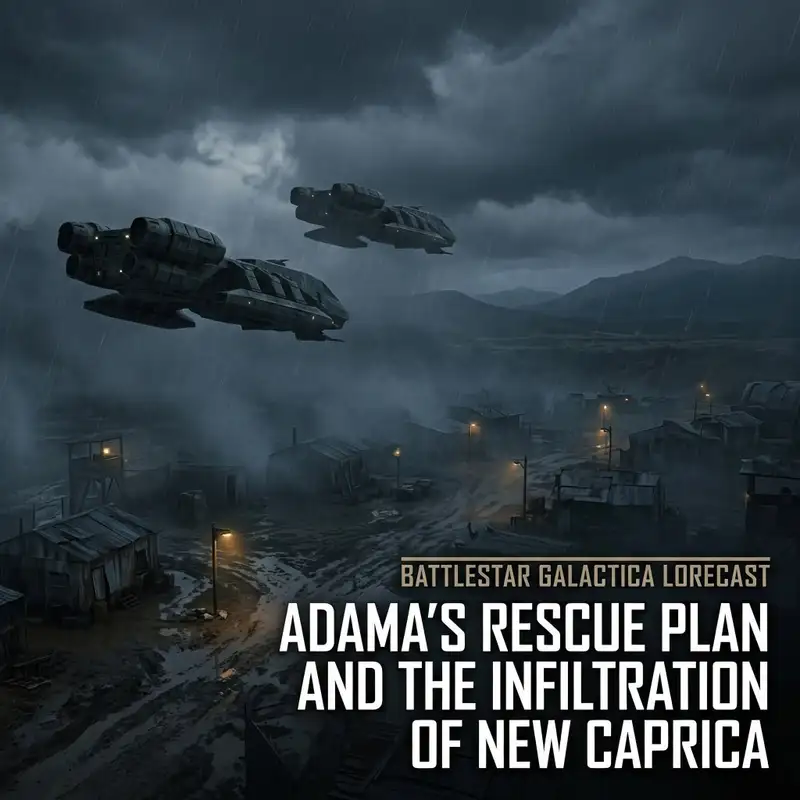
Adama’s Rescue Plan and the Infiltration of New Caprica
The civilian ships on New Caprica were still intact. Their hulls could carry the population away from the settlement. Their faster-than-light drives could return them to the fleet. But none of that mattered until someone recovered the launch keys held inside the Cylon detention system. An occupied population had been reduced to a problem of access authority. The decisive object was not a battlestar gun, a Viper, or a resistance rifle. It was a set of controls held behind enemy lines, guarded by an occupation force that controlled the prison, the streets, and the skies above the planet.
That was the essential difficulty of Adama’s rescue plan. He was not preparing to retake New Caprica and restore a Colonial government on the surface. He did not have the troops, supplies, or time for a conventional campaign. Nor could Galactica remain over the planet long enough to destroy every Cylon position. The mission was an extraction. Recover the civilians. Recover the grounded ships if possible. Break the occupation’s grip for a few minutes, perhaps a few hours, and then leave before the Cylon force could crush the rescue fleet.
The people on New Caprica had begun as settlers. They became an occupied population when the Cylons found the planet and landed in overwhelming strength. The settlement had never been an ideal refuge. Its environment was difficult, its resources limited, and its political order already strained by the decision to settle. Occupation made every weakness worse. Curfews, detention, executions, surveillance, Centurion patrols, and the use of human intermediaries turned ordinary civilian life into a system of pressure. The Cylons did not merely hold territory. They tried to make resistance seem futile, dangerous, and lonely.
Adama faced a divided responsibility. Galactica had left New Caprica with the free portion of the fleet. The choice had preserved ships and civilians who could escape, but it had also left thousands behind. Four months later, the admiral could not treat those people as an unfortunate loss on a strategic map. They were the same civilian population his battlestar had been created to defend. Yet he also had to preserve enough of the fleet to survive if the rescue failed. A commander can order a warship into danger. He cannot casually gamble the last functioning framework of a civilization.
That made the operation an exercise in calculated insufficiency. Adama lacked secure communications with the surface. He lacked a complete picture of Cylon forces around the planet. He lacked uncontested control of space. He lacked the transports required to lift an entire settlement by military means. He lacked the ability to replace Galactica if she was destroyed. What he possessed was a resistance network, a small number of highly capable ships, experienced crews, and the willingness of people on the ground to risk everything for a chance to leave.
The first requirement was not firepower. It was preparation inside the settlement.
Occupation gave the resistance its purpose, but it also gave it its military value. Saul Tigh, Samuel Anders, Galen Tyrol, Jean Barolay, Tory Foster, and many others did not form a conventional army. They had no secure rear area, no dependable supply line, and no open training ground. They operated through relationships, hidden stores of weapons, improvised communications, and the difficult judgment of whom to trust. Their network had to survive not only Cylon surveillance, but fear, exhaustion, and the presence of human police working under the occupation.
The underground had learned that the occupier’s strength was not unlimited. Centurions could patrol streets and enforce checkpoints, but they could not know every private conversation. Cylon surveillance could punish overt opposition, but it could not easily eliminate local knowledge. The resistance could hide weapons, identify sympathetic civilians, observe routines, and establish routes through the settlement. Its members understood which buildings offered cover, which officials could be approached, and which families needed warning first. That knowledge was not glamorous, but it was the foundation of the later evacuation.
Weapons hidden in the temple became part of that foundation. The temple massacre that followed was not merely another act of occupation violence. It reshaped the political atmosphere of New Caprica. It showed civilians that the occupation was prepared to answer suspected resistance with collective terror. It also hardened people who might otherwise have tried to remain neutral. For an underground movement, atrocity can produce recruits, but it can also produce fear, grief, and a desire for revenge that complicates discipline. Resistance grows under pressure, but pressure does not make it orderly or morally uncomplicated.
Tigh’s network therefore had to do more than plan attacks. It had to create the conditions for collective movement. An occupied population cannot be evacuated if every family hears the plan for the first time under fire. Civilians have children, injured relatives, ration cards, work assignments, homes, and reasons to fear that a sudden order to run may be a trap. The resistance needed people to know where to go without fully telling them why. That requirement produced one of the operation’s most important deceptions.
Anders and Tory Foster helped organize evacuation exercises presented as fire drills. On the surface, a drill was a mundane safety measure. Under occupation, it was something more useful. It accustomed civilians to moving toward designated areas and toward the grounded ships without announcing that those ships might someday become an escape fleet. It gave organizers a way to identify bottlenecks, confusion, and people who needed help. It created a pattern of movement that could appear harmless until the moment it became part of a mass evacuation.
This was operational deception at the human level. The objective was not to convince the Cylons that nothing was happening forever. It was to avoid exposing the full purpose of repeated civilian movement before the rescue force arrived. A fire drill gave colonists a plausible reason to assemble, a familiar route to follow, and a procedure to remember when panic was likely. The drill replaced some of the information that could not safely be transmitted over open channels. It turned routine into a form of clandestine preparation.
The limits were obvious. A rehearsal cannot make a frightened population calm while weapons fire is echoing through the settlement. It cannot guarantee that every family will remain together. It cannot ensure that a detainee will be released in time, that an elderly civilian can reach a ship, or that an informer will not recognize the pattern. But it reduced the risk that the evacuation would collapse into thousands of separate decisions. In an operation with almost no margin for delay, that mattered as much as any weapon.
Still, civilians could not flee in ships whose launch authority remained in Cylon hands. The resistance had created routes and procedures. It needed someone who could open the final gate.
Sharon Agathon was uniquely suited to that task, and uniquely exposed by it. She was a newly commissioned Colonial officer, a member of Galactica’s crew, the wife of Karl Agathon, and the mother of Hera. She was also a Number Eight humanoid Cylon. Her body and model identity gave her access to spaces and systems unavailable to a human operative. Her loyalty to the fleet, however, was not a property of her model line. It was individual, formed through captivity, coercion, love, motherhood, and the relationships she had built among humans who had learned, imperfectly, to trust her.
Her role on New Caprica was larger than simple espionage. She served as liaison between Galactica and the resistance, helping connect a force in orbit with people who knew the settlement from the inside. With Anders, she determined that the civilian ships’ launch keys were held in the detention center. The discovery converted a vague problem into a precise mission. The ships did not need to be repaired by some miraculous effort. They needed the authority to launch restored. That authority was concentrated in a place the resistance could not easily storm without triggering the alarm.
The mission also placed Sharon under pressures no ordinary intelligence operation could separate from its human cost. Hera had been taken from her. Sharon believed her daughter dead. The Cylons had manipulated that grief before, and they remained capable of using it again. Any contact with Cylon personnel could become an intelligence opportunity, a trap, or an emotional assault. Adama’s plan required Sharon to act with the discipline of an officer while carrying a private wound that the enemy understood better than most of her own allies did.
That was the burden of insider access. It can solve one problem while creating another. The Colonials did not suddenly understand Cylon systems because Sharon could enter a Cylon facility. They had a narrow opening through one person, for one purpose, under conditions that could change without warning. If the operation succeeded, the fleet would have the launch keys. If it failed, the Cylons would know that the rescue was underway before Galactica had created the space for it.
Sharon entered the detention center and reached the Cylon system holding the keys. The act was quiet, but its consequences were strategic. A prison had become the logistical center of the evacuation because the occupation had concentrated control over civilian mobility there. Recovering the keys meant that the civilian ships could shift from grounded assets into transport vessels. Without that shift, all the resistance planning in the world would have produced only a crowd trapped beside empty hulls.
Then Number Three confronted her and made a claim designed to cut through every professional defense Sharon had built. Hera, she said, was alive. The statement mattered because it came from a Cylon who had reasons to know things Sharon did not. But it was not proof of omniscience. Sharon had no way to verify it in that moment. Number Three’s knowledge, like much Cylon knowledge, was bound up with identity, belief, experience, and information Sharon could not see. The claim created pressure. It did not resolve the truth.
Sharon chose the mission. She shot Number Three in the legs rather than killing her, taking the keys and buying time before the alarm could spread. The decision was tactical. A wounded opponent could be left behind long enough to delay an immediate response. It was also revealing. Sharon did not become an uncomplicated weapon for humanity merely because she fought against the Cylons. She remained a person making a hard choice about force, loyalty, and survival under conditions that allowed no clean answer.
The launch keys removed the evacuation’s central bottleneck. They did not remove the Centurions from the streets, the Cylon force from orbit, or the possibility that the settlement would be destroyed before the ships could leave. On the ground, the escape mechanism now existed. In space, Adama still had to create time for it to work.
The rescue force depended on a fragile command arrangement. Adama directed Galactica’s operation. Lee Adama commanded Pegasus. Laura Roslin remained the political center of the effort and a vital connection to the resistance, even though the old constitutional order had been badly damaged by settlement and occupation. The civilian fleet remained a separate responsibility. It contained the people, labor, food, medical capacity, and technical skill necessary for survival beyond one battle. Any commander who forgot that in pursuit of a rescue could win the fight around New Caprica and still lose the future.
Adama did not attempt to defeat the full Cylon presence through direct battle. He used Raptors to project decoy signatures suggesting that two additional battlestars were approaching. The deception exploited expectation. If the Cylons believed a larger Colonial force was arriving, they would have to redistribute their basestars and Raiders to meet a threat away from the planet. Galactica did not need the Cylons to believe the fiction forever. It needed them to act on it briefly.
This was economy of force in its purest form. The humans had insufficient ships to dominate the battlespace, so they tried to make their actual force appear larger than it was. The decoys persuaded the Cylons to move attention outward. That movement created an opening around New Caprica. But the maneuver did not blind every sensor, erase every reserve, or establish some general Colonial mastery of electronic warfare. It created uncertainty in an enemy command system that had to make a rapid decision with incomplete information.
Adama’s own information was incomplete as well. He could estimate what Cylon units might be present, but he could not be certain how many basestars waited in or beyond the surrounding nebula. He could not know how quickly they would respond once the deception began to unravel. This was not carelessness. Commanders rarely receive the enemy order of battle they would prefer. The question is whether they can act responsibly with the intelligence available. Adama’s plan was a calculated risk, built around the recognition that waiting for perfect information would leave the people on New Caprica in permanent captivity.
The decoys drew Cylon attention away from the planet. Galactica’s next move placed the battlestar where no cautious commander would normally want it.
Galactica jumped directly into New Caprica’s upper atmosphere. The ship emerged over the settlement and began to fall. The maneuver was not normal flight operations. A battlestar was built for combat in space, not for extended atmospheric descent under gravity. The purpose was shock. Galactica appeared where Cylon defenders had not expected a capital ship to appear, at an altitude and angle that made the operation’s urgency unmistakable. For a brief interval, surprise did what superior numbers could not.
As the battlestar descended, the flight decks began launching Vipers. The sight of fighters leaving a falling capital ship is dramatic, but its military value was more specific. Vipers attacked Centurion positions and guard towers, suppressed defenses, and helped clear routes through which civilians and resistance fighters could move. They were not winning the war for New Caprica. They were buying room for people on the ground to reach the ships before Cylon control could reassert itself.
That support depended on a system, more than on brave pilots. Deck crews had to prepare aircraft and launch them under extraordinary conditions. Pilots had to fly into a confused ground battle with limited intelligence and limited time. Maintenance crews had to keep enough Vipers serviceable for immediate use. Fuel, ammunition, recovery procedures, and communications all mattered. The fleet had no deep reserve of pilots or airframes. Every aircraft committed to New Caprica was an asset that might not return.
The atmospheric jump also revealed something about Galactica’s character as a warship. The old battlestar was resilient, heavily built, and crewed by people accustomed to improvisation. But resilience is not immunity. The maneuver damaged the ship, including systems vital to continued combat and faster-than-light movement. Galactica created an opportunity by spending some of its own endurance. A ship can survive an extraordinary maneuver and still emerge less capable of surviving the next one.
At the last possible moment, Galactica jumped back into space before striking the planet. The feat achieved its immediate purpose. Cylon defenses on the ground had been disrupted. Resistance cells had an opening. Civilians who had practiced moving during fire drills now had reason to follow those routes for real. But a successful surprise maneuver is not the same as control of the battlespace. The operation had entered its most dangerous phase, because it was now visible, irreversible, and running against the clock.
The rescue window opened, but the wider tactical situation was worse than Adama expected.
Additional basestars emerged from the nebula. Galactica now faced a Cylon force it could not hold off alone. The decoys had worked in the limited sense that they drew enemy units away from New Caprica. But the deception had not created an empty sky. It had exposed the limits of the available estimate. A commander can force an opponent to move the pieces he sees. He cannot assume there are no other pieces beyond the edge of his intelligence picture.
This distinction matters because it separates intelligence failure from command failure. Adama had not designed a foolish plan merely because more basestars appeared. He had designed a rescue around uncertain information because uncertainty was unavoidable. What the new contacts revealed was that the operation had no meaningful reserve. Galactica had committed itself to the rescue with too little combat power to absorb a larger enemy response. Once the additional basestars arrived, the battlestar could not remain indefinitely without risking destruction.
The dilemma was brutal. If Galactica withdrew too early, the civilians on the surface would be abandoned a second time. If it stayed, it might be destroyed before the evacuation was complete, leaving the free fleet without its flagship and without the people it had returned to save. The entire plan had been built around synchronization. Sharon had to acquire the keys. Resistance cells had to trigger their actions. Civilians had to move. The grounded ships had to launch. In orbit, Galactica had to keep the corridor open just long enough.
Pegasus had been assigned a different responsibility. Lee Adama had been ordered to remain with the civilian fleet and continue the search for Earth if Galactica failed. The order was strategically rational. A surviving Pegasus, protecting the civilians, offered continuity if the rescue became a disaster. It prevented one father’s determination to recover the abandoned population from automatically risking every remaining human asset. It also placed Lee in the position every subordinate commander dreads: obey a sound order, or violate it because the situation has changed.
Lee chose to bring Pegasus into the battle.
His intervention was tactically decisive. Pegasus arrived with greater firepower than Galactica could provide alone and immediately relieved pressure on the damaged battlestar. The newer ship could engage Cylon capital vessels and force them to divide their attention. Its arrival altered the immediate calculation around New Caprica. Galactica no longer had to stand alone between the basestars and the evacuation. The rescue force had gained time, and time was the resource every part of the operation required.
Strategically, however, the decision was ruinous in the way many necessary decisions are ruinous. Pegasus was the fleet’s strongest remaining combat asset. It also represented modern systems, repair depth, and a level of manufacturing capacity the fleet could not easily replace. Its ability to produce replacement Vipers had already demonstrated the difference between a warship that can improvise and a warship that retains some industrial capability. Losing Pegasus would not just reduce the fleet’s firepower. It would narrow the future options available to everyone who survived.
Institutionally, Lee’s act remained disobedience. The fact that it worked does not erase that. Military command depends on subordinates understanding that a commander’s broader responsibility may require painful orders. Yet command also depends on subordinates recognizing when the situation has changed beyond the assumptions of the original plan. Lee judged that leaving Galactica to die would not preserve the fleet. It would sacrifice the rescue, destroy the flagship, and leave the civilian population divided between those in space and those under occupation.
Pegasus entered the battle without the full weight of its people and aircraft aboard. Much of its crew, fighters, and Raptors had remained with the civilian fleet, where they were needed for protection and continuity. That limited what the ship could sustain. It also reflected the hard arithmetic of the rescue. The operation did not place every surviving resource at New Caprica. Some capability had to remain with the civilians in case the battle ended badly. Even in extremis, the fleet could not entirely forget that survival required more than one dramatic engagement.
As the fight intensified, Pegasus became a delaying force. Lee ordered the crew to abandon ship, retaining the battlestar long enough to continue firing automatically. The ship then drove into a basestar. The collision destroyed that enemy vessel, and the wreckage of Pegasus’s starboard flight pod contributed to the destruction of another. The action was tactically effective. It removed Cylon ships that might otherwise have pursued or destroyed the withdrawing Colonials.
But Pegasus did not leave the battle as a damaged vessel to be repaired later. It was gone. Its destruction was a sacrifice in the strict military sense: a deliberate expenditure of an irreplaceable asset to secure a greater immediate objective. The fleet gained the people of New Caprica. It lost a battlestar that had brought modern capability, manufacturing capacity, trained personnel, and a measure of redundancy to a force that possessed very little redundancy. The explosion was not the end of a heroic spectacle. It was the closing of a strategic option.
In orbit, Pegasus bought time. On the ground, the resistance had to convert that time into movement.
The ground battle was not intended to destroy every Centurion or seize permanent control of the settlement. Resistance fighters set off coordinated explosions, seized weapons, attacked occupation positions, and freed detainees. Each action had a narrow purpose. Fragment Cylon control. Force defenders to respond in multiple directions. Open routes. Release people who would otherwise be left behind. Keep the occupation from concentrating force on the launch areas before the civilian ships could depart.
Tigh, Anders, Tyrol, Tory, Barolay, and the wider network carried different parts of that burden. Some organized fighters. Some managed civilians. Some fought directly. Some used knowledge acquired through ordinary life under occupation. Their roles mattered because no single command post could see the whole evacuation. The operation depended on distributed initiative. Resistance cells had to act when communications were unreliable and conditions changed faster than orders could travel.
Viper support helped make those local actions possible. Colonial fighters attacked Cylon positions and reduced the immediate pressure on routes leading to the ships. Yet air power did not eliminate danger for the civilians below. A Viper can suppress a tower or strike a Centurion position. It cannot gather a scattered family, persuade a terrified person to leave a home, or decide which detainee gets through a gate first. The essential work remained human and local. The resistance had prepared people to move, and now those people had to move while the settlement came apart around them.
The fire drills paid their quiet dividend. Civilians knew enough to head toward the ships rather than waiting for a central authority that no longer existed. But rehearsed movement became real movement under conditions of terror. Families were separated. Former prisoners emerged from detention. People who had survived months of coercion had to decide whether to trust an escape plan that could still fail. The evacuation was organized, but it was never orderly in the bureaucratic sense. It was a population trying to become mobile before an enemy regained control.
The occupation’s human consequences were present in every part of that movement. Some people carried wounds from detention. Some carried grief for relatives killed earlier. Some had collaborated in ways they could not explain away. Some had fought in the resistance and feared retaliation if captured. Some had done neither, yet had still been marked by hunger, surveillance, and the knowledge that a Cylon patrol could redefine their lives at any moment. Extraction could remove them from New Caprica. It could not remove the occupation from their memories.
As Cylon control collapsed on the ground, divisions within the occupation leadership became as important as its weapons.
The Cylons were not acting with one simple, unanimous will. Caprica Six, Cavil, Number Three, Number Five, and others could disagree about coercion, coexistence, punishment, and the meaning of the occupation. Some recognized that escalating brutality had failed to produce stable control. Others were prepared to destroy the settlement rather than allow it to escape. These differences did not make the occupation less violent. They did reveal that even a technologically superior force can suffer from political division when its strategy turns conquest into an unsustainable system of repression.
Number Three chose the most destructive fallback. With the evacuation underway, she remained behind to trigger a nuclear weapon planted in the settlement. The purpose was not to restore order. It was to deny the escaping population a future and to convert military failure into mass death. That choice showed the final collapse of occupation authority. A regime that cannot govern and cannot withdraw coherently may turn to annihilation as its last assertion of power.
Baltar stood near the center of this crisis, but his presidency had long ceased to be independent authority. Under Cylon occupation, his formal position gave him access and visibility, not genuine control over the forces determining life and death around him. Felix Gaeta, holding Baltar at gunpoint, forced him to act against Number Three and prevent the detonation. It was an act shaped by coercion, fear, and desperate necessity. It did not restore Baltar’s legitimacy, and it did not simplify Gaeta’s own moral position.
The nuclear threat was stopped, but the moment exposed how thoroughly the old political arrangement had disintegrated. Cylon leaders no longer agreed on the limits of force. Baltar could not command the occupiers who had used him. Gaeta acted through a weapon because normal authority had become hollow. On the ground, the resistance and civilians were already leaving. The occupation had not been defeated by a clean surrender. It had broken apart under military pressure, internal division, and the sudden loss of control over the people it had tried to govern.
The strategic picture was harsher. The fleet had gained people but lost Pegasus, its most capable remaining battlestar and one of its few sources of industrial depth. Galactica remained in service, but age, damage, and attrition could not be wished away. The operation had proven that coordination, surprise, and sacrifice could overcome an enemy advantage in a specific moment. It had not restored a shipbuilding network, replenished trained crews, or rebuilt the civilization destroyed at the Fall.
Politically, rescue did not restore normal constitutional life. Roslin’s authority, Baltar’s compromised presidency, the legitimacy of the Quorum, the conduct of the resistance, and the role of those who had served under occupation would all remain contested. Military success gave the fleet a population to govern. It did not give that population a shared account of what had happened. People who had endured the same occupation could emerge with sharply different memories of fear, complicity, courage, betrayal, and loss.
The rescue also left moral injuries that no launch key could unlock. Resistance violence had saved lives and taken lives. Collaboration had occurred under conditions ranging from ambition to coercion. Detainees had been abused. Families had been separated. Some survivors had been forced to make decisions they could defend only partially, if at all. The end of occupation brought relief, but it also brought judgment. A society that has survived by secrecy and emergency action must eventually decide what it owes the people who were harmed in its name.
Adama’s plan worked because it replaced the conventional advantages he did not possess with coordination among people who had learned to act under pressure. Sharon obtained access. The resistance created movement. Galactica created surprise. Pegasus purchased time. Together, those actions turned an occupied settlement into an evacuation route, but they did not produce a clean victory. They exchanged New Caprica’s captivity for a damaged fleet, the destruction of Pegasus, and a survivor society whose political and moral wounds could not be evacuated with the civilian ships.